Living Together
The different ways organisms affect one another — predator and prey, competition for resources, and cooperation.
⏱ 10 min · 🎯 4 things to master
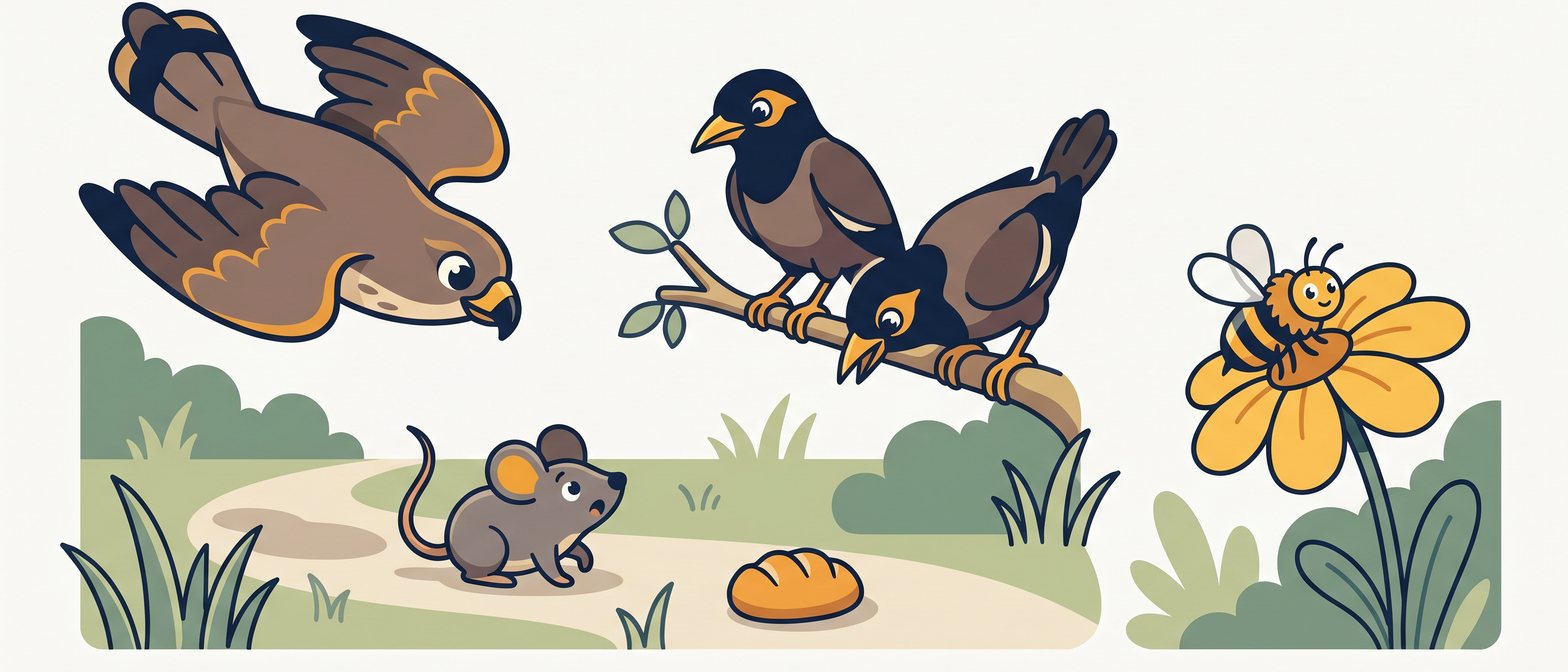
No living thing is an island. A spider waits for a fly. Two mynahs in the school field both spot the same crust of bread at the exact same moment. A bee lands on a flower and gets a free meal — while the flower gets something useful in return. Every organism in nature is tangled up in the lives of others, and those tangles follow patterns that scientists — and PSLE markers — have names for.
Parents: let your child tap through the relationship-classifier below before you read the explanations together. Saying the keyword out loud ("predator-prey") the moment they tap it is the fastest way to make it stick — quicker than reading it three times.
By the end you will be able to look at any pair of organisms and name how they interact. The four ideas we will nail are: predator and prey, competition, cooperation, and why it matters who benefits and who gets hurt.
When One Hunts the Other: Predator and Prey
Have you ever watched a cat freeze, tail low, eyes locked on a lizard? That cat is about to eat — and the lizard is trying very hard not to be eaten. This is the most dramatic interaction in nature, and it has a precise name.
The organism that hunts and eats another is the . The organism that is hunted and eaten is the . The hawk hunts the mouse — the hawk is the predator, the mouse is the prey. The lion stalks the zebra — the lion is the predator, the zebra is the prey. The frog snaps at the fly — the frog is the predator, the fly is the prey.
One clear rule: the predator benefits (it gets food and energy); the prey is harmed (it loses its life).
🤔 Predict first: A hawk swoops and catches a mouse to feed its chicks. Which organism is the predator?
When Two Want the Same Thing: Competition
Two plants growing side by side in your school garden will both reach their leaves upward. Not because they are cooperating — they are fighting, in slow motion, for the same patch of sunlight. In the longkang near your block, two monitor lizards may chase the same fish. This is .
Competition happens when organisms want the same resource and there is not enough for both. The resource can be:
- Food — two eagles targeting the same rabbit
- Water — trees in a dry field with roots pulling from the same soil
- Space — weeds crowding out seedlings in a garden
- Mates — two male peacocks displaying for the same female
The key point: both organisms are harmed compared to what they could have if the other were not there. Neither gets as much food, water or space as it needs.
When Two Help Each Other: Cooperation
Not every interaction is a fight. A clownfish lives safely among the stinging arms of a sea anemone; in return, the clownfish chases away fish that try to eat the anemone. The clownfish gets shelter; the anemone gets a bodyguard. Both win. This is .
The most equal kind of cooperation is — both benefit. A bee collecting nectar from a flower is the classic example. The bee gets food; the flower gets pollinated so it can produce seeds. Both gain something.
Some organisms cooperate within their own group too — soldier ants defend the colony while worker ants gather food. Meerkats take turns as lookouts to warn the group about eagles. Working together helps the whole group survive.
🤔 Predict first: A bee visits a flower, drinks nectar, and carries pollen to the next flower. Who benefits?
When One Benefits and the Other Is Harmed: Parasitism
A tick buries its head in a dog's skin and drinks blood. The tick gets fed; the dog gets itchy, tired, and sometimes very ill. One organism benefits while the other is harmed — but the harmed organism stays alive (which is different from predation, where the prey is eaten completely). This one-sided relationship is called .
The organism that benefits is the . The organism that is harmed is the . A tapeworm living inside a cat's intestines is a parasite; the cat is its host. The parasite needs the host to stay alive — which is why it does not kill it quickly.
Classify the Relationship
Now try classifying the pairs yourself. Predict what the relationship is, then tap each card to check.
What is the relationship between these organisms?
Predict first: What is the relationship between a hawk and a mouse?
Watch Out — Easily Mixed Up
Quick Recap
🎯 Mastery check
Answer all 8 — your progress is saved on this device.
A hawk swoops down and catches a mouse for food. What is the relationship between the hawk and the mouse?
Two mynahs both spot the same piece of bread on the void deck floor. What type of interaction is this?
A bee collects nectar from a flower and carries pollen to the next flower it visits. Which word best describes this interaction?
A tick lives on a dog and feeds on its blood. The dog becomes weak and itchy but stays alive. What is this relationship called?
Two mango trees in a garden have their roots tangled, drawing from the same water in the soil. Which type of interaction is this?
In a group of meerkats, one stands on a rock and gives a warning call when it sees an eagle, so the rest of the group can hide. How would you describe this behaviour?
What is the difference between a predator-prey relationship and a parasite-host relationship?
A clownfish hides among a sea anemone's stinging arms for shelter. The clownfish chases away fish that try to eat the anemone. Which keyword best fits this interaction?