Light Energy
How light travels in straight lines from a source, reflects off surfaces so we can see objects, and forms shadows when something blocks its path.
⏱ 10 min · 🎯 4 things to master
Pick up your pencil case and look at it. You can see it — but your pencil case does not glow. So how do your eyes know it is there? The answer is light. A light source somewhere in the room sends out light rays. Those rays hit your pencil case, bounce off, and travel to your eyes. Without a light source, you cannot see anything at all. In this note you will discover how light moves, why mirrors are special, and the science words that help you explain what you observe.
Parents: each section has a short interactive step — let your child predict before they tap "reveal" or "fire". Saying the keyword out loud is how it sticks. The whole note takes about 15 minutes to try together.
By the end you will be able to explain: how light travels, the difference between a light source and an object we see by reflected light, how reflection works, and when shadows form. Let's start with the most surprising fact.
Light Travels in Straight Lines
Hold a torch in a dark room and switch it on. The beam goes straight. It does not curve around your furniture or sneak through a wall — it goes in a perfectly straight line until it hits something. This is always true: always travels in straight lines.
You can prove it yourself. Line up three cards, each with a small hole in the centre, one behind the other. When all three holes are in a line, you can see the light through them. Tilt just one card — the light disappears, because the path is no longer straight. Light cannot bend around the hole.
Here is the key science sentence: light travels in straight lines.
🤔 Predict first: If you put a closed book between a small torch and a wall, what will the shadow on the wall roughly follow?
Light Sources vs Objects We See by Reflected Light
Flick off every light in your room at midnight — total darkness. Now switch on a lamp. You can instantly see the lamp (it glows) and you can also see your desk, your books, your chair. But those objects are not glowing by themselves. So why can you see them?
A produces light on its own. The sun is a light source; it burns and gives out light. A lamp is a light source; electricity makes the bulb glow.
Most objects around you are not light sources. Your desk, your book, your face — none of these make their own light. You can see them because light from a source hits them, and some of that light bounces off the surface and travels to your eyes. We say you see them by .
🤔 Predict first: The moon looks very bright at night. Is the moon a light source, or do we see it by reflected light?
Reflection: Light Bounces Off Surfaces
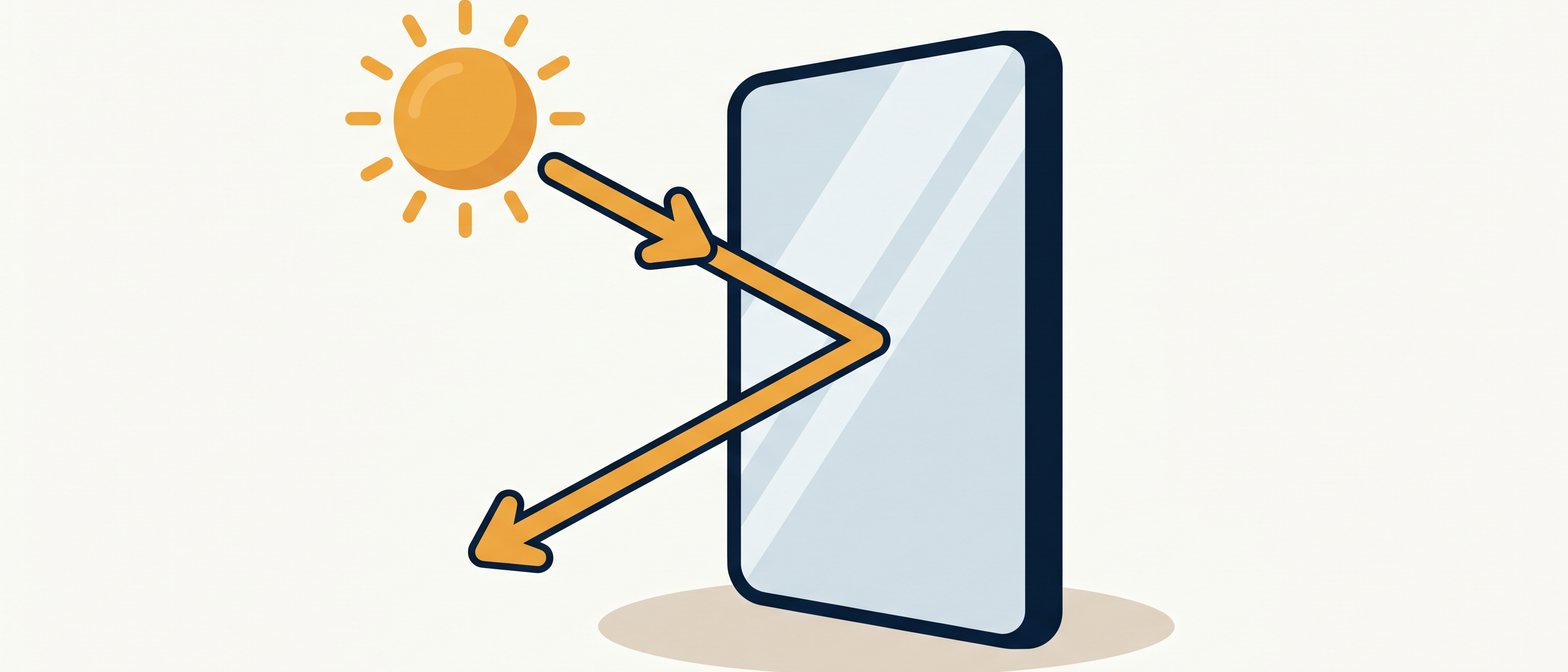
When light hits a surface — especially a smooth, shiny one such as a mirror or still water — it can bounce off. This is called .
You can still explore the bounce by changing the mirror's angle. Watch how the reflected ray changes direction in the optional experiment below.
Aim the light ray at the target
Predict first: If light hits a mirror at a slant, which way does it bounce?
Shadows: What Happens When Light Is Blocked
When an object blocks all or part of a light beam, a dark or partly dark area forms on the other side — a shadow. Because light travels in straight lines, the middle of a shadow often follows the object's outline. Its edge can be sharp or fuzzy depending on the size and position of the light source, the object, and the wall.
This note is focused on light sources and reflection, and the companion note Properties of Materials goes deeper into how materials let light through. The key link is: an object blocks light and forms a shadow because light travels in straight lines. If you meet the optional words transparent, translucent, and opaque, they describe whether most, some, or none of the light passes through; they are extra vocabulary for this note, not needed for the core P4 idea.
🤔 Predict first: A student holds a clear glass cup in front of a lamp. Will there be a shadow on the wall?
Watch out — these are easily mixed up
Quick recap
🎯 Mastery check
Answer all 8 — your progress is saved on this device.
Why can you see your school bag even though it does not glow?
Which of these is a light source?
A student uses three cards with holes to test whether light bends. When she tilts the middle card, the light disappears. What does this show?
A torch shines on a mirror. What happens to the light at the mirror?
The moon looks very bright on a clear night. Which statement about the moon is correct?
A student places a cardboard sheet and a clear glass cup in front of a lamp, one at a time. Which object is more likely to make a dark shadow, and why?
Your friend says "light reflects off a mirror and then curves toward the ceiling." Is she correct?
You want to light up a dark corner in your bedroom by bouncing torchlight off a mirror on the wall. This is possible because of which property of light?