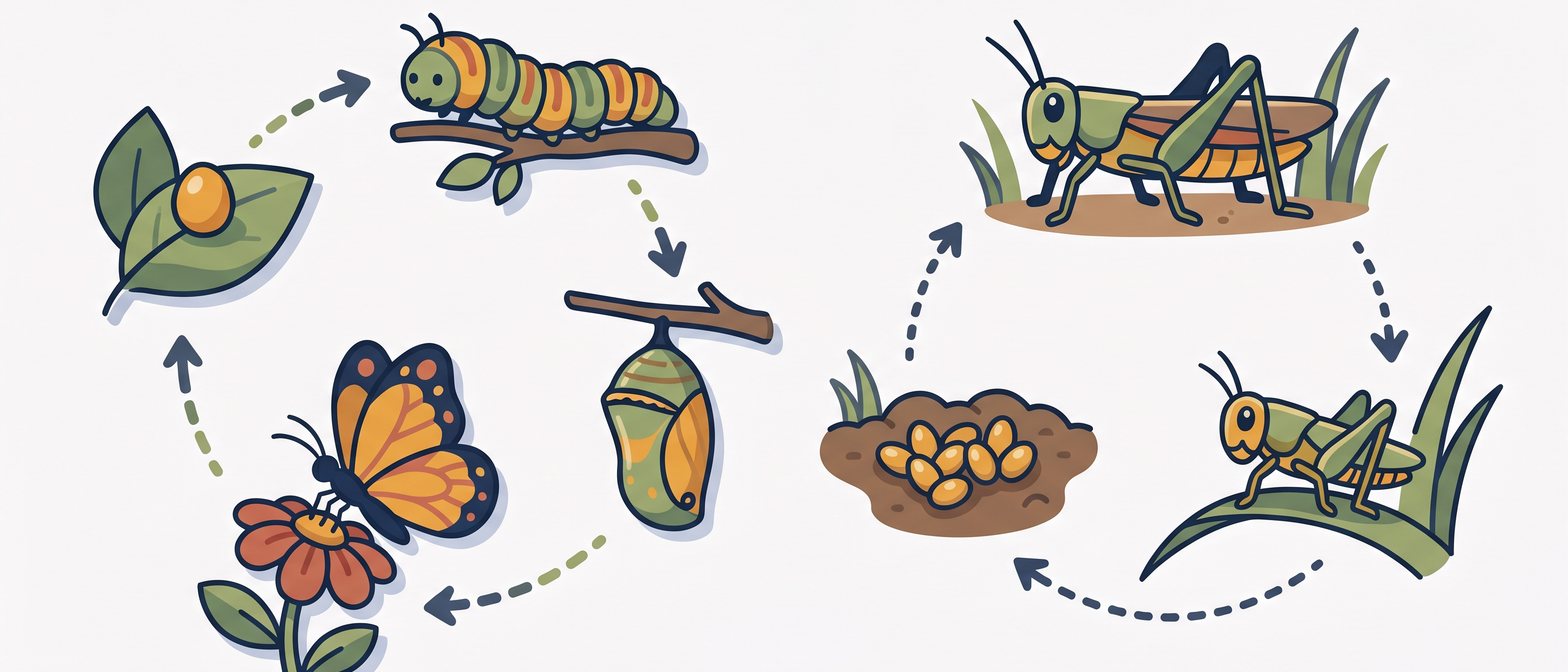
Life Cycle of Animals
The stages animals pass through as they grow up, and the difference between complete metamorphosis, incomplete metamorphosis and no metamorphosis.
⏱ 9 min · 🎯 3 things to master
Here is a question that many P5 students get wrong: does a young grasshopper look like a little version of its parent, or does it look completely different? The answer changes everything about how you describe its life cycle — and the PSLE marker is listening for one specific word.
Parents: let your child tap through the life-cycle walker below before reading the explanations. Ask them to predict whether the young grasshopper looks like its parent, then walk through a butterfly to compare. Saying the keywords out loud — "complete metamorphosis", "incomplete metamorphosis" — is how they stick.
By the end of this note you will be able to describe any animal's life cycle using the exact words the PSLE marker awards. The three patterns to master are: complete metamorphosis, incomplete metamorphosis, and no metamorphosis. They all start with an egg — but what happens next is very different.
Complete Metamorphosis
A butterfly does not hatch from its egg looking like a butterfly. Not even close. What hatches is a — in the butterfly's case, a caterpillar. The caterpillar eats and grows, then goes through a resting stage called a (or chrysalis). Inside the pupa, the body is completely rebuilt. Out comes a butterfly — an adult that looks nothing like the caterpillar it once was.
This four-stage pattern — egg, larva, pupa, adult — is called . The mosquito follows the same pattern: egg, wriggling larva (called a wriggler), tumbling pupa (called a tumbler), adult mosquito.
The key sign is the pupa stage and the fact that the young looks completely different from the adult.
Walk the butterfly and mosquito through the interactive life-cycle walker and see each stage for yourself.
Walk a life cycle
Predict first: Does a young grasshopper look like its parent?
Incomplete Metamorphosis
Now try the grasshopper in the life-cycle walker above. A grasshopper egg hatches into a . The nymph already has the grasshopper's body shape — two long hind legs, antennae, and the same general look as its parent — but it is much smaller and has no wings yet. The nymph moults (sheds its skin) several times, growing bigger each time, until it finally becomes a full adult with wings.
Notice what is missing: there is no pupa stage. The young never looks completely different from the adult. This three-stage pattern — egg, nymph, adult — is called . The cockroach follows the same pattern.
The key sign is that the young (nymph) already resembles the parent, and there is no pupa stage.
🤔 Predict first: A cockroach egg hatches. The young cockroach (nymph) already looks like a tiny adult. Is this complete or incomplete metamorphosis?
No Metamorphosis
Walk the chicken through the life-cycle walker. A chick hatches from its egg already looking like a tiny chicken — fluffy, two legs, a beak. It does not go through a larva stage, a nymph stage, or a pupa stage. It just grows. This pattern is called a life cycle with no metamorphosis.
Animals with no metamorphosis include chickens, ducks, and humans. The young always resembles the parent from the moment it is born or hatched. Humans are born as babies who already have all the features of the adult body, just much smaller.
🤔 Predict first: A human baby is born. Does this show complete metamorphosis, incomplete metamorphosis, or no metamorphosis?
Watch out — these are easily mixed up
Quick recap
🎯 Mastery check
Answer all 8 — your progress is saved on this device.
A butterfly starts as an egg, then becomes a caterpillar, then forms a chrysalis, then becomes an adult. What type of metamorphosis is this?
A grasshopper nymph already has the body shape of an adult grasshopper but has no wings yet. What type of metamorphosis does the grasshopper undergo?
Which stage is found in complete metamorphosis but NOT in incomplete metamorphosis?
A mosquito larva (wriggler) lives in still water and looks nothing like an adult mosquito. Which type of life cycle does the mosquito have?
A baby chicken hatches from an egg and already looks like a tiny chicken. Which life cycle pattern does this show?
A student says a caterpillar is a "nymph". Why is this wrong, and what is the correct term?
You are studying an insect and notice it has no pupa stage. Its young already looks like a smaller version of the adult. Which type of metamorphosis should you record?
List the four stages of complete metamorphosis in the correct order.