Human Respiratory System
How the nose, windpipe and lungs work together to bring oxygen into the blood and push carbon dioxide out, breath by breath.
⏱ 9 min · 🎯 5 things to master
You take about 20 000 breaths every day without thinking about it. Right now, as you read this, air is flowing in through your nose, down a tube in your neck, and deep into your lungs — where your blood quietly picks up a gas your body cannot live without. That process is not just breathing. It is a system: a set of parts working together to keep every cell in your body alive.
Parents: let your child predict the gas name in the first section before they tap to reveal, and let them toggle INHALE and EXHALE in the experiment themselves. Saying the useful phrase ("gaseous exchange, oxygen in, carbon dioxide out") while tapping it helps the idea stick.
By the end you will be able to trace the path of air from your nose to your lungs, describe inhalation and exhalation, explain gaseous exchange in the lungs, and say why your body needs oxygen. The path, gas exchange and need for oxygen are the P5 core; diaphragm/rib mechanics and alveoli are optional enrichment.
The path of air
Take a slow breath in right now. Where does that air go? It does not just jump into your blood — it travels down a very specific route.
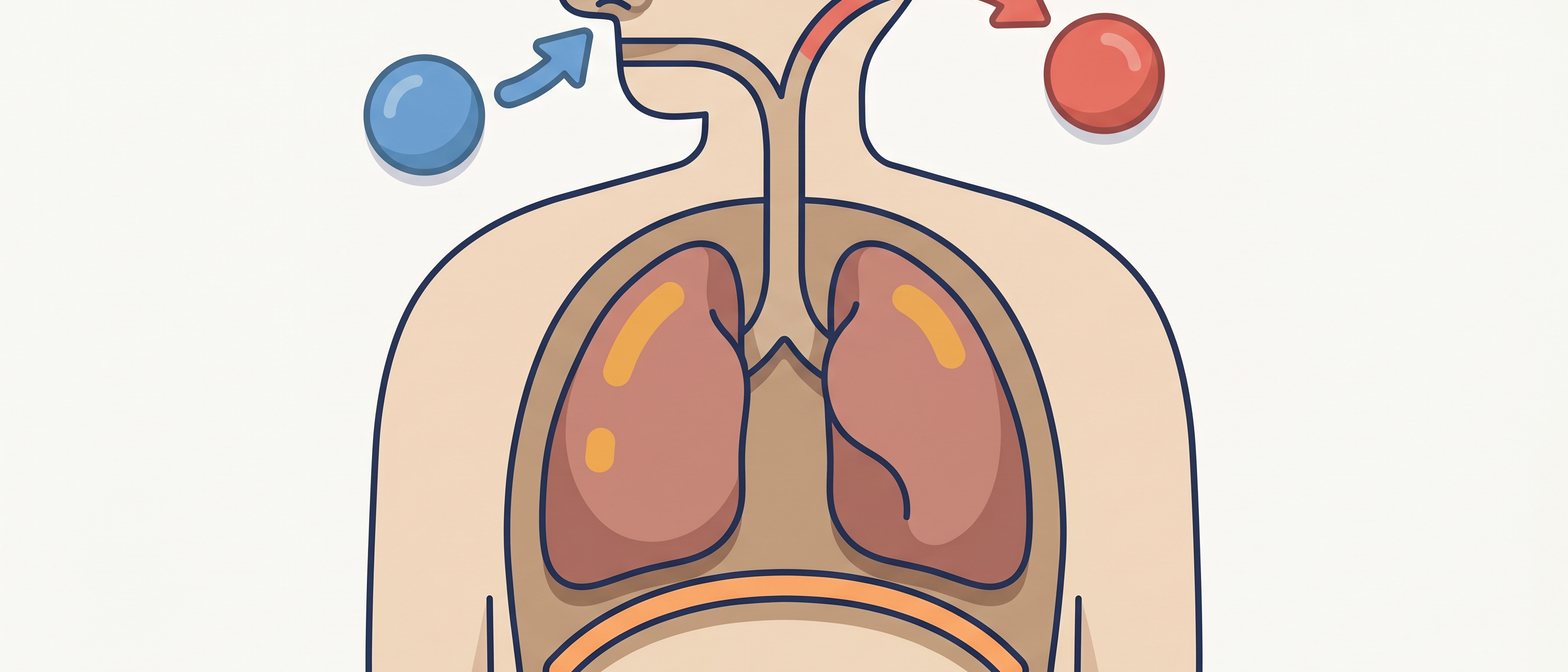
Air enters through your . Tiny hairs inside trap dust and germs. The air is also warmed and moistened so it will not damage the delicate tissue further inside.
From the nose, air flows down the , which is your windpipe. You can feel it — run your finger down the centre of your neck and you will feel firm rings of cartilage keeping it open. The trachea splits into two branches, one for each . Your two lungs sit inside your ribcage, protected by the curved bones around them.
🤔 Predict first: Air travels from the nose to the trachea and then to the ___?
Inhalation and exhalation (with optional diaphragm enrichment)
Your body does not have muscles in its lungs to squeeze air in and out. Instead, two sets of muscles change the size of your chest, and air follows:
- : a large, dome-shaped muscle that sits below your lungs.
- (intercostal muscles): they move your ribs up and out.
Inhalation (breathing in): The diaphragm contracts and flattens. The rib muscles pull the ribs up and out. Your chest gets bigger. Air rushes in to fill the extra space — just like opening a bellows.
Exhalation (breathing out): The diaphragm relaxes and domes upward. The rib muscles relax, and the ribs fall down and in. Your chest gets smaller. Air is pushed out.
Try the experiment. Tap INHALE and EXHALE to see your diaphragm move, your lungs expand and shrink, and air rush in or out.
How do we breathe? Explore inhalation and exhalation
Predict first: Which gas does your body take IN when you breathe?
Gaseous exchange in the lungs
Air reaches the lungs. Now what? As optional enrichment, the tiny air sacs where gaseous exchange happens are called (one is an alveolus). Their walls are just one cell thick, and they are wrapped in a web of tiny blood vessels.
Here is the swap that happens every second:
- Oxygen passes from the air in the alveoli through the thin walls into the blood. The blood carries it to every cell in your body.
- Carbon dioxide — a waste gas made by your cells — passes from the blood into the air in the alveoli, and you breathe it out.
This swap is called . It is the whole point of breathing.
🤔 Predict first: During gaseous exchange, which gas passes FROM the blood INTO the air in the lungs?
Why we breathe: cells need oxygen
Breathing keeps you alive because your cells use oxygen to release energy from food — a process called . This explanation gives useful context; detailed cellular-respiration timing is optional enrichment rather than a P5 requirement.
Carbon dioxide is the waste product of this process. Your blood carries it back to the lungs so it can leave the body during exhalation. This is why the two gases travel in opposite directions: oxygen in, carbon dioxide out.
🤔 Predict first: Your cells need oxygen to do what?
Watch out — these are easily mixed up
Quick recap
🎯 Mastery check
Answer all 8 — your progress is saved on this device.
List the correct order of the path air takes when you breathe in.
When you inhale, what does the diaphragm do?
What happens to the ribs during exhalation?
During gaseous exchange, which gas passes from the lungs into the blood?
Why do our cells need oxygen?
A student says "we breathe in carbon dioxide and breathe out oxygen." What is wrong with this?
After a long run, Maya breathes faster. Why does her body need more oxygen at this moment?
Which tube carries air from your nose to your lungs?