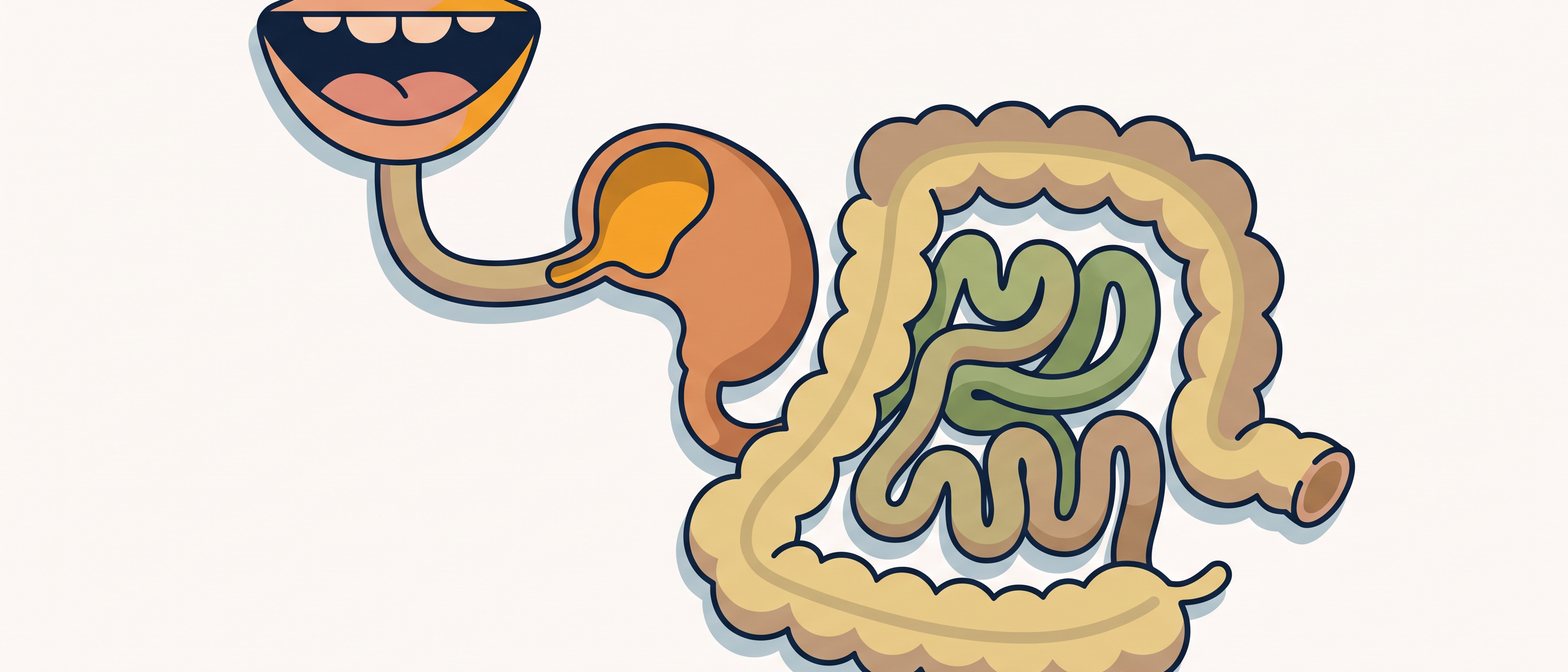
Human Digestive System
The journey food takes from mouth to large intestine, where it is broken down, and where digested food and water are absorbed.
⏱ 8 min · 🎯 4 things to master
Every meal you eat goes on a long journey inside your body before your cells actually get any energy from it. That bowl of rice you had for lunch? It travelled through five organs before the nutrients could reach your muscles and brain. By the time it was done, your body had broken it down into tiny bits small enough to pass through the walls of your gut and into your blood. That two-step process has a name: digestion and absorption — and once you understand them, the PSLE question is easy.
Parents: the interactive sim below lets your child follow a piece of food through each organ — let them predict where absorption happens before tapping through. Saying the keyword out loud is how it sticks.
By the end you'll be able to trace the path food takes through the body and explain what happens at each stop. The four ideas we'll master are: the path of food, digestion (breaking down), absorption in the small intestine, and what the large intestine does. Let's go.
The Path Food Takes
The digestive system is a long tube running from your mouth to your bottom. Food travels through five main parts, in this order: mouth → gullet (oesophagus) → stomach → small intestine → large intestine. Each part has a job to do.
Think of it like a production line at a factory in Jurong. The raw materials (your food) go in one end, get processed at each station, and useful products (nutrients) are sent out to the workers (your body cells) while leftover material is removed as waste.
🤔 Predict first: Which organ comes right after the stomach in the digestive system?
Digestion — Breaking Food Down
Have you noticed that you cannot just put solid food straight into your blood? Your blood vessels are tiny — nothing chunky can fit through. So your body has to break food into pieces that are small enough to pass through. That is what is.
Digestion starts in your mouth. Your teeth chew the food into smaller pieces, and your saliva (spit) starts to break it down chemically. Then the food is squeezed down the gullet (oesophagus) — a muscular tube that pushes it into the stomach. In the stomach, the food is churned and mixed with digestive juices that break it down further into a thick paste. By the time the food reaches the small intestine, digestion is complete — the food has been broken all the way down into tiny dissolved particles.
The key word is . It happens from the mouth all the way through to the small intestine.
Try the journey yourself:
Follow the food — where does it go?
Predict first: Where are digested nutrients absorbed into the blood?
Absorption — Nutrients Enter the Blood
Breaking food down is only half the story. The tiny particles produced by digestion still need to get out of the gut and into your blood so they can reach every cell in your body. That second step is called .
Absorption happens in the small intestine. The walls of the small intestine are packed with tiny finger-like structures that give it a huge surface area. Digested nutrients pass through these walls and enter the blood, which then carries them to every cell in your body.
This is the single most important fact in this topic: absorption of digested food into the blood happens in the small intestine — not the stomach, not the mouth.
🤔 Predict first: Where in the body are digested nutrients absorbed into the blood?
The Large Intestine — Water and Waste
After the small intestine has done its job, there is still some water and material left over that the body cannot use. This leftover mixture passes into the large intestine. Here, water is absorbed back into the body (your body does not want to waste it). The solid material that remains becomes , which is stored until it leaves the body.
So the large intestine has two jobs: absorb water and remove solid waste. It does not do any digestion — that work is already finished by the time food arrives here.
Watch out — these are easily mixed up
These are the mistakes that cost marks every year. Learn to spot them now.
Quick recap
🎯 Mastery check
Answer all 8 — your progress is saved on this device.
Put these organs in the correct order: stomach, small intestine, mouth, large intestine, gullet.
What is digestion?
Where in the digestive system are digested nutrients absorbed into the blood?
What are the TWO main jobs of the large intestine?
A student says absorption of nutrients happens in the stomach. Why is this wrong?
Where is digestion completed in the digestive system?
Which organ connects the mouth to the stomach, pushing food downward?
Mia eats a plate of chicken rice. Which organ absorbs most of the water from the leftover material after digestion?