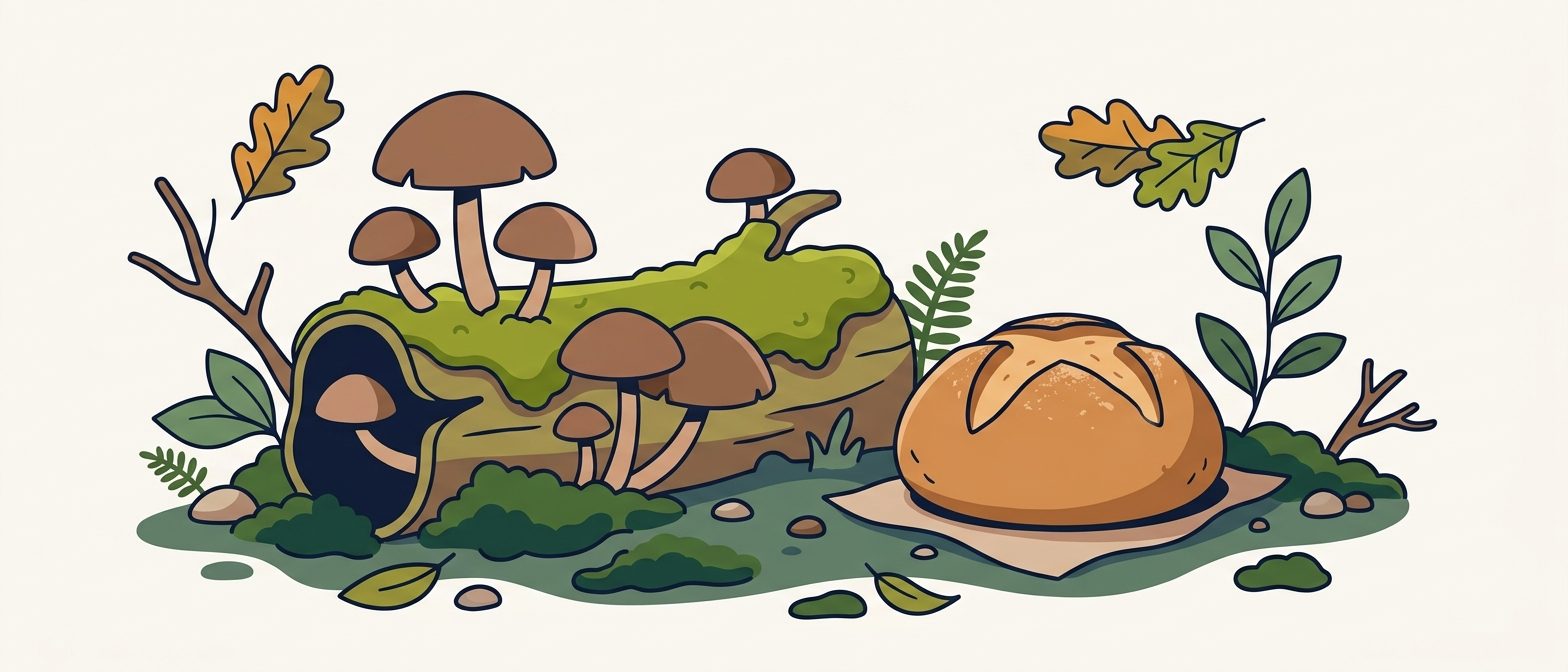
Fungi
Why mushrooms, mould and yeast are not plants, how they feed and break down dead matter, and which fungi are useful or harmful.
⏱ 8 min · 🎯 4 things to master
Quick question: is a mushroom a plant? It grows in the ground, it cannot walk, and it looks a little like a tiny umbrella. But the answer is no — a mushroom is a fungus, and fungi are their very own group of living things. Here is the surprise that catches everyone out: the same family of living things makes your bread rise and makes old bread go furry and rotten. Fungi can be your friend at the dinner table and your enemy in the bread bin. In this note you will learn what makes a fungus a fungus, then sort the helpful ones from the harmful ones yourself.
Parents: the blue dotted words are tappable definitions, and the "Teacher's tip" boxes name the exact keyword the PSLE marker awards. Let your child predict before each reveal, and play the sorting game together — 15 minutes of doing beats an hour of reading.
By the end you'll be able to explain why fungi are not plants, how they break down dead matter, and tell a useful fungus from a harmful one. Let's dig in.
What makes a fungus a fungus?
Fungi reproduce using tiny, dust-like , rather than forming seeds like flowering plants. The spores float away in the air, land somewhere suitable, and grow into new fungi. This is why a single mouldy strawberry can quickly spread fuzz to the fruit next to it — the spores travel.
Now the big one. Plants are green because they contain , which lets them make their own food from sunlight. Fungi have no chlorophyll. They are not green, and that means a fungus cannot make its own food. So how does it eat? A fungus feeds on other living things, dead or alive. Mushrooms often grow on a rotting log or fallen leaves because that is their meal.
Have you noticed where many mushrooms and moulds love to grow? In damp, warm, dark places — under a log, in a forgotten lunchbox, on bread left in a humid kitchen. Those conditions often help fungi grow well.
Change the conditions yourself and watch what happens to the mould — does it thrive or struggle?
Where does mould grow best?
Predict first: Which slice of bread grows mould fastest?
When a fungus feeds on dead matter, it breaks it down into simpler substances. This breaking-down process is called , and it causes the dead matter to . Because fungi break down dead things this way, we call them . That fuzzy log on the forest floor is slowly being recycled.
🤔 Predict first: True or false: Fungi are green plants that make their own food.
Useful fungi
Fungi are not the enemy — many of them help us every single day.
First, food. Many mushrooms are edible and we eat them: button mushrooms in your pasta, shiitake in a stir-fry, enoki in a steamboat. These are fungi grown to be eaten.
Next, baking and brewing. A special fungus called makes bread dough rise so your bread turns out soft and fluffy. The same yeast is used to make beer and wine. Without yeast, bread would be a flat, hard lump.
Fungi also keep nature tidy. As decomposers, they break down dead plants and animals and return nutrients to the soil. That makes the soil rich again, like a natural fertiliser, so new plants can grow. Without decomposers, dead leaves and logs would pile up forever.
Finally, medicine. Penicillin, one of the first antibiotic medicines that fights harmful bacteria, comes from a fungus. A fungus has helped save many lives.
Harmful fungi
The same group of living things also has a harmful side, so be careful.
Not every mushroom is safe to eat. Some mushrooms are poisonous and cannot be eaten — eating the wrong one can make a person very ill. Never pick and eat a wild mushroom.
Then there is . Mould grows on food and causes the food to spoil. Eating mouldy food can give you food poisoning. Mould also damages other things — it can ruin leather shoes and bags left in a damp cupboard, and it makes bread go furry and inedible.
Fungi can even grow on people. Ringworm (an itchy ring-shaped rash on the skin) and athlete's foot (itchy, peeling skin between the toes) are both caused by fungi. So fungi can cause skin infections too.
Useful or harmful?
Time to sort them yourself. Predict the first one, then tap each fungus to decide whether it is useful or harmful and check the reason.
Sort the fungi
Predict first: Mould growing on your bread — useful or harmful?
Quick recap
🎯 Mastery check
Answer all 7 — your progress is saved on this device.
A mushroom does not grow from a seed. How do fungi reproduce instead?
Unlike a green plant, a fungus has no chlorophyll. What does this mean for the fungus?
Why do mushrooms and mould grow best in a forgotten lunchbox left in a humid kitchen?
A fungus on the forest floor breaks down a dead log into simpler substances. What is this process called?
How is a decomposer fungus useful to a forest?
Which of these is a useful fungus, and why?
Why is mould growing on your bread a harmful fungus?