The Forms and Conversion of Energy
The six P6 forms of energy — light, heat, sound, electrical, kinetic and potential — and how everyday devices convert one into another.
⏱ 10 min · 🎯 4 things to master
Your phone battery drains as you scroll. A kettle boils water for milo. A torch lights up the void deck at night. All of these things happen because energy is changing from one form into another. Scientists call this energy conversion, and once you understand it, you will spot it everywhere — from the moment you switch on the classroom fan to the second a rubber catapult launches a stone.
Parents: let your child predict the energy output before tapping each device in the interactive sim below. Saying the answer out loud ("I think it turns into heat") before seeing it is one of the fastest ways to make the keyword stick.
By the end you will be able to name the six P6 forms of energy, write a correct energy conversion chain for an everyday device, and use the exact words the PSLE marker is looking for. The four big ideas are: forms of energy, energy conversion, examples of conversions, and the conservation of energy rule.
The Six Required Forms of Energy
The P6 syllabus asks you to recognise and give examples of six forms of energy. Think of them as six different "flavours" — each one can do something different, and each has a special name.
travels from the sun to your classroom window. warms your hands when you hold a mug of hot Milo. lets you hear a hawker calling out your order. powers every plug socket in your HDB flat.
(also called movement energy) is in a football in flight and in the spinning blades of a fan. is stored and waiting — a book on a high shelf and a stretched rubber band are both examples. You may hear the more specific labels gravitational potential and elastic potential energy, but those labels are optional enrichment for P6. is another useful scientific term for energy stored in food, fuel and batteries, but it is also optional enrichment here.
🤔 Predict first: Which form of energy is stored inside a battery?
Energy Conversion
Here is the big idea: energy cannot stay still. It is always changing from one form into another. When you switch on a torch, the chemical energy in the battery does not disappear — it first becomes electrical energy, then becomes light energy. When you pull back a catapult, your muscles add elastic potential energy to the rubber; when you let go, that elastic potential energy becomes kinetic energy as the stone flies.
This changing from one form to another is called .
Here is the rule that every PSLE student needs to know: energy is never created or destroyed — it only changes form. This is called the conservation of energy. When a torch shines, energy is not lost — it has just become light energy (and a little heat energy, too).
Pick a device below, predict what form the energy changes into, then tap to see the full conversion chain.
What energy conversion happens here?
Predict first: A torch changes electrical energy into which form?
Key Examples You Must Know
The PSLE often tests whether you can match a device or situation to the correct conversion chain. These are the ones that appear most often.
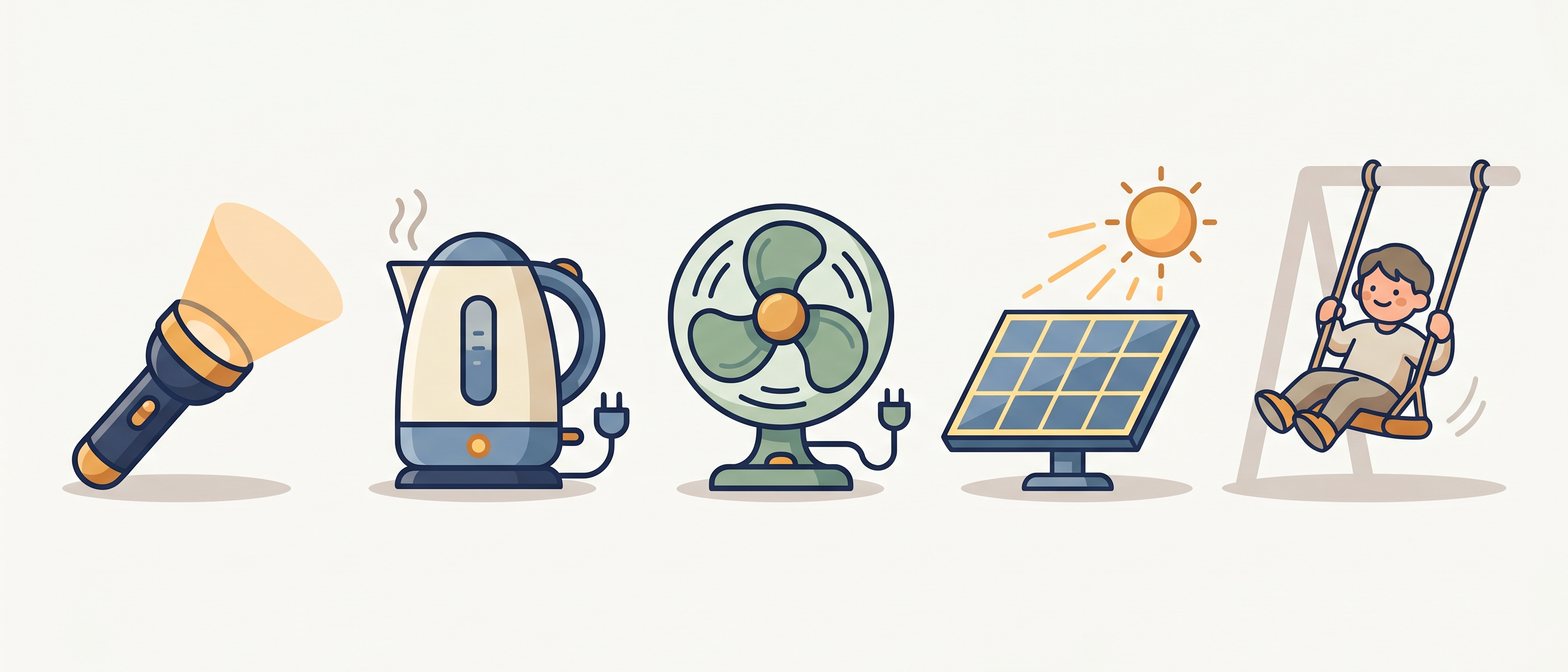
Electrical devices are the most common. A torch: electrical energy → light energy. An electric kettle: electrical energy → heat energy. An electric fan: electrical energy → kinetic energy. A radio or speaker: electrical energy → sound energy.
Batteries add one step. In a torch with a battery, the full chain is: chemical energy → electrical energy → light energy. The battery converts chemical energy to electrical energy first; then the bulb converts electrical energy to light energy.
Potential energy examples. A child at the top of a slide stores potential energy; as she slides down, it converts to kinetic energy. A stretched rubber band also stores potential energy; release it and it converts to kinetic energy. The more specific labels are optional enrichment.
Solar panels run the conversion in reverse of a torch: light energy → electrical energy. Sunlight hits the panel and produces an electric current. You might see this on HDB rooftops.
🤔 Predict first: A student blows into a whistle. Which energy conversion is happening?
Watch out — these are easily mixed up
Several pairs of terms look similar but mean different things. Spot the differences now and you will not lose marks.
Quick recap
🎯 Mastery check
Answer all 8 — your progress is saved on this device.
An electric kettle is switched on. Which energy conversion takes place?
An electric torch receives electrical energy and produces a beam of light. Which conversion is shown?
A child is at the top of a slide, ready to slide down. As she slides to the bottom, what energy conversion occurs?
A solar panel on a rooftop produces electricity. Which energy conversion is the solar panel doing?
A student says "the torch creates light energy from the battery." Why is this description wrong?
You pull back a rubber catapult and release a stone. Which energy conversion best describes what happens at the moment of release?
A radio plays music when plugged into the wall. Which form of energy does the radio produce?
Which of the following is an example of potential energy?