Forces
What a force is, and the everyday pushes and pulls — friction, gravity, elastic and magnetic — that start, stop and reshape moving things.
⏱ 11 min · 🎯 4 things to master
You push open your classroom door. You pull your school bag onto your shoulder. You kick a football. In each of these moments, something is happening that science has a name for: a force. Forces are all around you — and four of them show up again and again on the PSLE Science paper. Learn what they are, how to spot them, and the exact words the marker is looking for.
Parents: each section has a prediction step your child must complete before the experiment unlocks — let them think it through before tapping. The blue dotted words are tappable definitions, and the gold tip boxes name the precise PSLE keyword that wins marks.
By the end you will be able to describe any force situation using the four PSLE force keywords. Those four are: push or pull, frictional force, gravitational force, and elastic/spring force or magnetic force. Let's try each one.
What is a force?
Drop your pencil. It falls. Push your chair back from the table. It moves. Squeeze a stress ball. It changes shape. Something made all of those things happen — and that something is a force.
A is a push or a pull. A force can do five things to an object: start it moving, stop it, speed it up, slow it down, or change its direction or shape.
Here is a quick check before we go further.
🤔 Predict first: Your rubber eraser is sitting still on the table. You push it and it slides across. What did the push do?
Frictional force
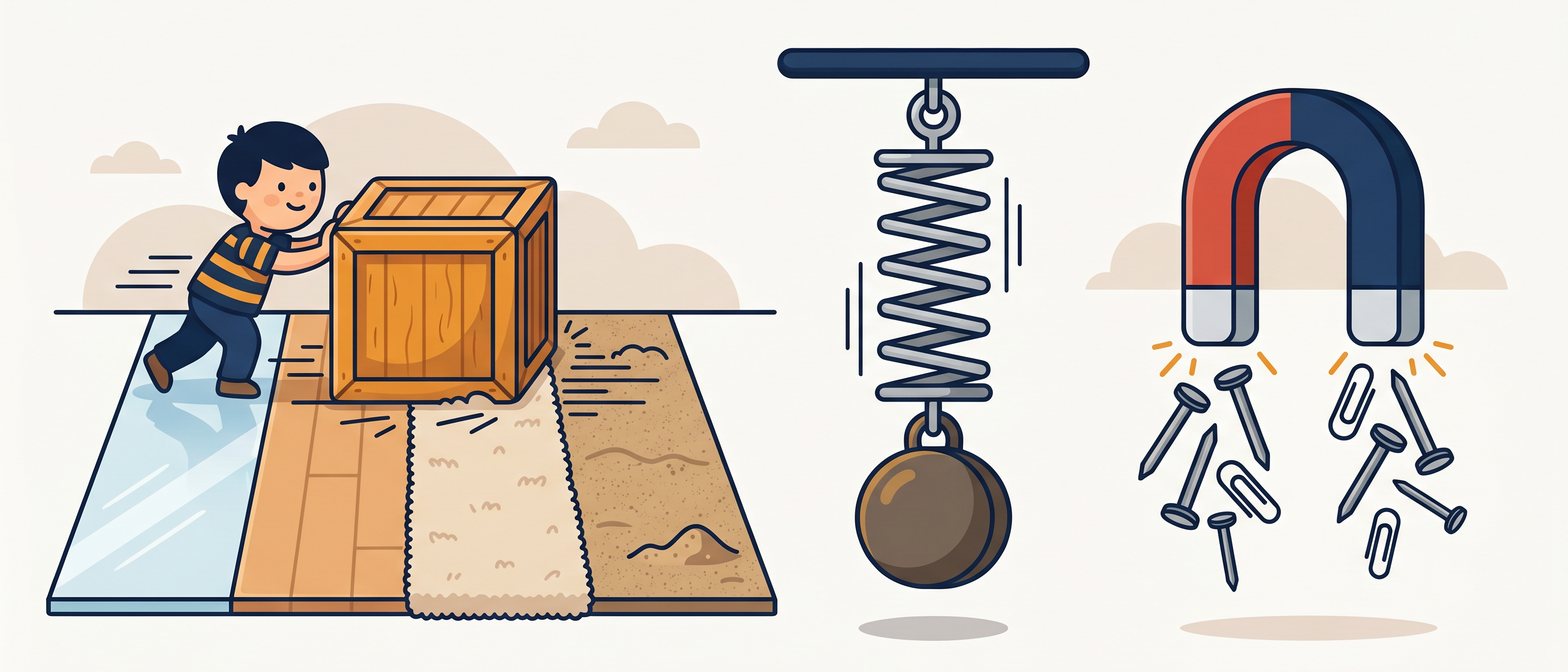
Your pencil case slides smoothly across the glass top of a display counter. The same pencil case barely moves when you push it across a rough concrete ledge. The difference is friction.
always works against the direction of motion — it tries to slow a moving object down and stop it. The key rule for PSLE: rougher surfaces produce more frictional force. A smooth ice rink produces very little friction, so a puck slides a long way. Sandpaper is very rough, so it produces a large frictional force that stops an object quickly.
Push the box across each surface below and see how far it slides.
Which surface lets the box slide the farthest?
Predict first: On which surface does the box slide the FARTHEST?
Gravitational force
Hold a marble above the floor and let go. It falls straight down — every single time. It does not float sideways; it does not hover. That is because the Earth is constantly pulling it downwards with a force you cannot see but can always feel.
is the pull of the Earth on every object near it. The more an object has, the greater the gravitational force acting on it. We call the size of this pull the object's . This is why a full 5-litre bottle of water is harder to lift than an empty one — more mass means more gravitational pull to work against.
🤔 Predict first: Two balls are dropped from the same height at the same moment. Ball A has a mass of 1 kg. Ball B has a mass of 5 kg. Which one hits the ground first?
Elastic force and spring force
Stretch a rubber band and feel the resistance in your fingers. Pull back the rubber of a slingshot — the further you pull, the harder it pushes back. Compress the spring on a retractable pen and feel it push your thumb away. These are all the same type of force.
(also called ) is produced when a stretchy material is deformed — stretched, squashed, or bent. The material tries to go back to its original shape, and that trying produces the force. A stretched rubber band releases this force to flick the paper. A compressed spring in a toy car releases it to make the car shoot forward.
🤔 Predict first: You compress the spring in a toy car and let go. Which force makes the car move forward?
Magnetic force
Hold two fridge magnets with the same poles facing each other. No matter how hard you try to push them together, an invisible force pushes them apart. Flip one around and they snap together without you doing anything. This invisible force that acts at a distance — without the magnet even touching — is the .
Magnetic force can attract (pull together) or repel (push apart), and it acts through air and some non-magnetic materials. It only acts on magnetic materials — iron, steel, nickel, and cobalt — and on other magnets.
🤔 Predict first: You bring a magnet close to an aluminium can. What happens?
Watch out — these are easily mixed up
Quick recap
🎯 Mastery check
Answer all 8 — your progress is saved on this device.
A goalkeeper catches a football and it stops moving. What did the goalkeeper's hands do to the football?
A box slides much farther on a smooth tile floor than on a rough carpet. Why?
You want to move a heavy box across the floor with the least effort. Which surface would give the least frictional force?
A stone is dropped from a tall building. Which force causes it to fall downwards?
A student says a 10 kg boulder falls faster than a 1 kg book when dropped from the same height. Is the student correct?
A rubber band is stretched and then released. Which force makes the rubber band spring back to its original shape?
You hold a magnet 2 cm away from an iron nail without touching it. The nail moves towards the magnet. Which force caused this?
A student brings a magnet near a copper pipe, an iron key, and a wooden ruler. Which objects are attracted to the magnet?