Food Chains and Food Webs
How energy passes from producers to consumers along a food chain, and how linked chains form a web where every organism depends on the others.
⏱ 10 min · 🎯 5 things to master
Every time a cat watches a bird from your HDB window ledge, it is looking at the end of a food chain. The bird ate a worm. The worm ate dead leaves. The cat wants to eat the bird. That chain of "who eats whom" is happening all around Singapore — in your neighbourhood park, the Sungei Buloh wetlands, even in a longkang (drain). Scientists call it a food chain, and once you see how it works, you will never look at a garden the same way again.
Parents: each section below has a predict question — please let your child answer it out loud before tapping to reveal. The interactive food-web experiment in the final section is the centrepiece: ask your child to remove one organism and then explain the knock-on effect in their own words. Saying the keyword aloud is how it sticks.
By the end you will be able to: identify producers, consumers, and decomposers, draw the arrow correctly, explain how a food web links many chains, and predict what happens when one organism is removed. Let's go.
Producers: the start of every chain
Here is a question. If a grasshopper eats grass, and a frog eats the grasshopper — where did all that energy come from in the first place? The answer is the grass. Green plants are special: they make their own food using sunlight, water and air through a process called photosynthesis. No other organism in the chain can do this.
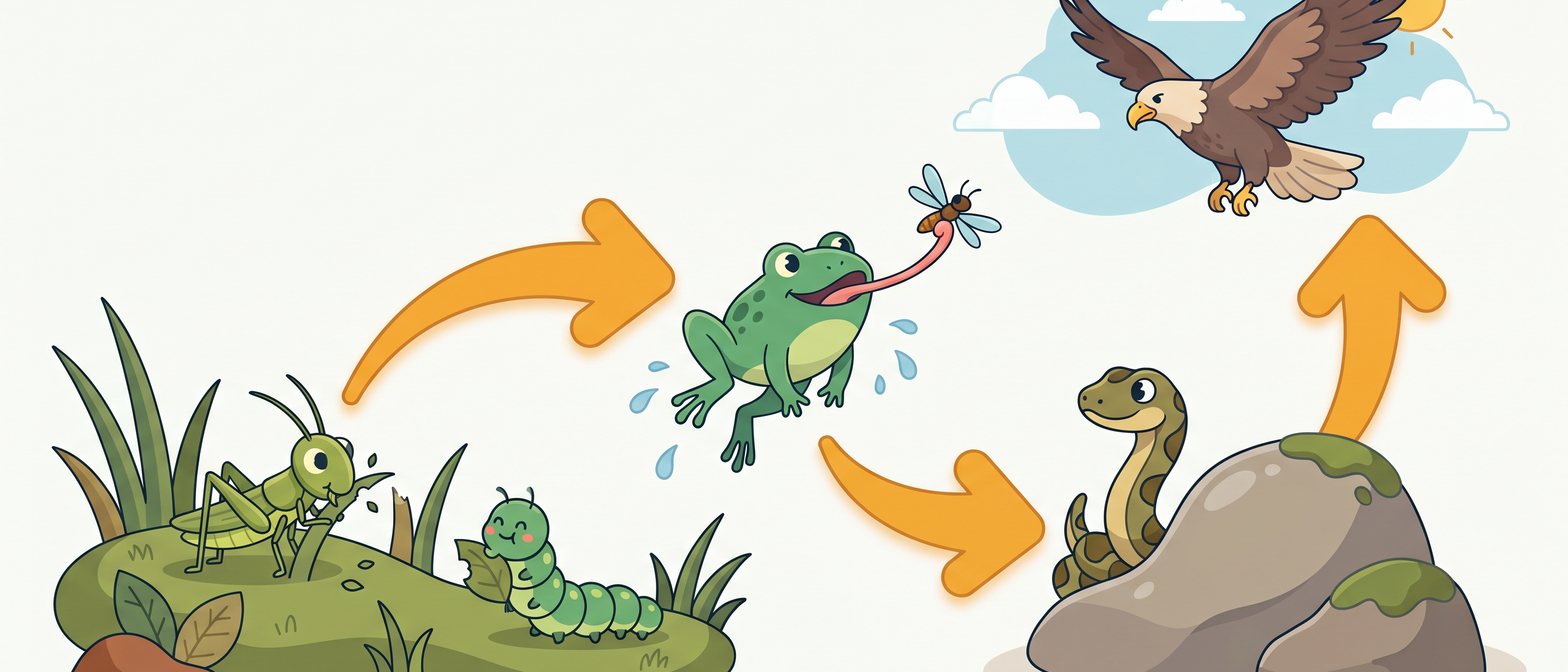
A is a living thing that makes its own food. Green plants and algae are common producers in PSLE examples. In a school pond food chain you might have: pondweed → water snail → fish → heron. The pondweed is the producer. In the void-deck garden: grass → grasshopper → frog → snake → eagle. The grass is the producer.
🤔 Predict first: In the chain 'grass → grasshopper → frog', which organism is the producer?
Consumers: the rest of the chain
Animals in these chains are because they get energy by eating other living things. Consumers are split by what they eat:
- — eats plants only. Grasshoppers, cows, rabbits.
- — eats animals only. Frogs, snakes, eagles.
- — eats both. Humans, birds like the mynahs you see in Singapore.
A herbivore is sometimes called a primary consumer (it eats the producer directly). A carnivore that eats the herbivore is a secondary consumer. The eagle at the top, which eats snakes, is a tertiary consumer.
Some consumers do a different job from animals in a grazing chain. such as fungi and some bacteria break down dead matter. They return nutrients to the environment, so new plants can grow. They are part of the P6 environment story even though this simple web shows only plants and animals.
🤔 Predict first: A cow eats only grass. A lion eats only cows. Which label fits each one?
The arrow: what it really means
Look at this food chain: Grass → Grasshopper → Frog → Snake → Eagle
The arrow does NOT mean "eats." It means energy flows to or is eaten by. So the arrow points from the food to the feeder. Grass is eaten by the grasshopper, so the arrow goes: Grass → Grasshopper. The grasshopper is eaten by the frog, so: Grasshopper → Frog.
This is the exact wording the PSLE marker wants. Writing "the arrow means eats" is wrong — write "the arrow shows the direction of energy flow" or "means is eaten by."
🤔 Predict first: In the chain Leaf → Caterpillar → Bird, what does the arrow between Leaf and Caterpillar show?
Food webs: when chains link up
A single food chain is neat and simple — but real ecosystems are messier. A frog does not eat just grasshoppers; it also eats caterpillars. An eagle does not eat just snakes; it also eats frogs. When many food chains share organisms and overlap, the result is called a .
Food webs matter because they show us what happens when one organism disappears. Remove the frogs and the grasshoppers have no predator — their numbers shoot up. The snakes, which relied on frogs for food, start to go hungry. One removal sends ripples through the whole web.
Try it yourself. In the sim below, remove one organism from the food web and see the knock-on effect. Also use the Identify buttons to label each organism as a producer or consumer.
Food Web: remove an organism and see the knock-on effect
Predict first: If all the frogs disappear, what happens to the grasshoppers?
Watch out — these are easily mixed up
Quick recap
🎯 Mastery check
Answer all 8 — your progress is saved on this device.
In the food chain: Algae → Water snail → Carp → Heron — which organism is the producer?
In the food chain: Grass → Rabbit → Fox, what does the arrow between Rabbit and Fox show?
A grasshopper eats only leaves and grass. It is best described as a…
In a food web: Grass → Grasshopper → Frog → Snake → Eagle. If all the frogs suddenly disappear, what happens to the grasshopper population?
In the same food web, if all the grass disappears, what happens to the eagle population?
A crow eats both insects and berries. Which label fits best?
A student draws: Frog ← Grasshopper. Is this correct? Why or why not?
A dead leaf is broken down by a fungus in the soil. What role does the fungus play?