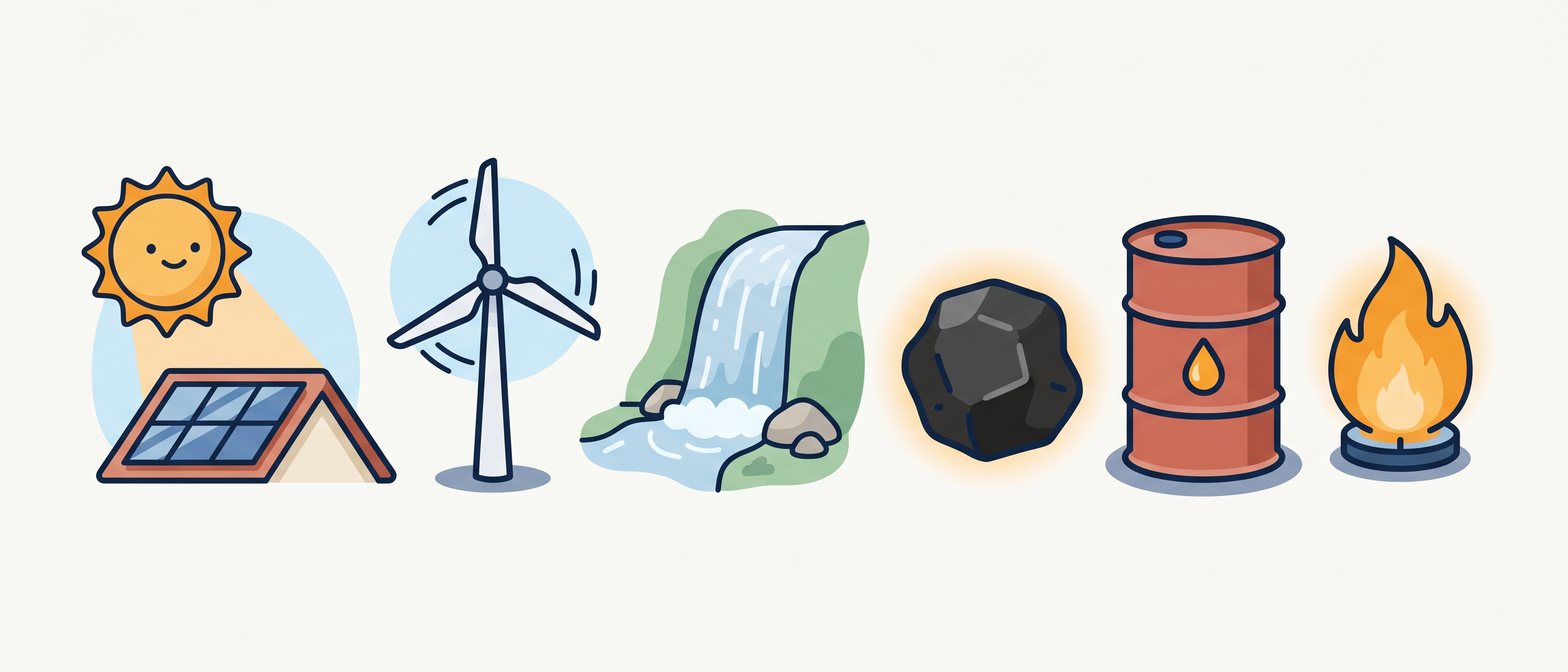
Energy Sources
Where our energy comes from — the Sun, naturally replenished sources, and non-renewable fossil fuels that take millions of years to form.
⏱ 10 min · 🎯 4 things to master
Every time you switch on a fan in your HDB flat, you are using energy. Every time a plant grows in your school garden, it is using energy. But where does all that energy come from? Here is the surprising truth: for almost every living thing on Earth, the answer is the same — it starts with the Sun. Understanding where energy comes from, and whether it will last, is one of the most important ideas in PSLE Science.
Parents: let your child predict before each reveal, especially the sorting game below — saying the keyword out loud is how it sticks. Five minutes of active sorting beats twenty minutes of reading.
By the end you will be able to explain why the Sun is our main energy source, tell the difference between renewable and non-renewable sources, name the fossil fuels, and say why we should save energy and switch to cleaner sources. Four big ideas — let us tackle them one by one.
The Sun: the energy behind almost everything
Think about what you ate for breakfast this morning. Rice, bread, an egg, or a banana — every one of those came from a plant or from an animal that ate plants. Now ask yourself: how did those plants grow? They grew by soaking up . Without the Sun, plants cannot make food. Without plants, animals have nothing to eat. Without animals and plants, there is no food for you either.
The same is true for almost every living thing on our planet. Even the fish in the sea eat tiny plants that need sunlight to grow. The Sun is the starting point for nearly every food chain. That is why we say the Sun is the main source of energy for almost all living things.
🤔 Predict first: A deep-sea fish lives where sunlight never reaches. Could it still depend on the Sun for its energy?
Renewable energy sources
You have just been outside at a playground. Was there wind? Wind is naturally replenished. Now look up at the sky on a sunny day. The Sun will rise again tomorrow. In places with flowing rivers or tides, moving water is naturally replenished too.
These three — sunlight, wind, and moving water — are naturally replenished. Their availability can change with weather and place, but they are renewable energy sources because they are not used up in the way fossil fuels are.
Singapore uses solar panels on some HDB rooftops to capture sunlight. Countries with strong winds use tall . Places with large rivers build — hydro means water. All three are renewable.
Non-renewable energy sources and fossil fuels
Now imagine digging up a lump of coal from the ground and burning it. Once it is burned, it is gone. The coal took millions of years to form underground from ancient plants and animals that died and were slowly compressed. Humans are burning it in decades. Once it is all used up, it will not come back in our lifetimes — or in our great-great-grandchildren's lifetimes.
Coal, oil, and natural gas are all formed this way. We call them . Because they took so long to form and we are using them much faster than they can be replaced, they are called .
Burning fossil fuels also releases gases that harm the air — another reason to use less of them.
Sort the sources — try the experiment
Now try sorting all six energy sources yourself. Pick one, then drop it into the right bin. The sim gives you feedback the moment you place it.
Sort the Energy Source: Renewable or Non-Renewable?
Predict first: Will the wind ever run out as an energy source?
Why we should save energy and use cleaner sources
Here is a simple sum. If we keep burning coal, oil and natural gas at today's speed, they will run out — and future generations will have nothing. Burning them also releases gases that warm the planet and dirty the air. Both problems point to the same two solutions:
- Save energy — use less electricity at home (switch off lights, use fans instead of air-con at lower settings, unplug chargers) so less fossil fuel may be burned to generate electricity.
- Use renewable sources where suitable — solar panels, wind turbines, and hydroelectric power use replenished sources and can reduce the need to burn fossil fuels during generation.
Solar panels on some Singapore rooftops are an example of using a renewable energy source. These projects can help reduce reliance on fossil fuels.
🤔 Predict first: Your school switches its electricity supply from coal power to solar power. Which problem does this help with?
Watch out — these are easily mixed up
Quick recap
🎯 Mastery check
Answer all 8 — your progress is saved on this device.
A lion eats a zebra. The zebra ate grass. The grass grew using sunlight. Which organism is the original source of energy in this food chain?
Which THREE of the following are renewable energy sources? (Choose the best answer listing all three.)
Coal was formed from ancient plants buried underground millions of years ago. Why is coal a non-renewable energy source?
Name the three fossil fuels.
Singapore installs solar panels on HDB rooftop. Which best explains why this is a good idea?
A student says: "We should use more fossil fuels because they give us lots of energy." Give TWO reasons why this is a bad idea.
A hydroelectric dam uses the movement of a river to generate electricity. Which type of energy source is this?
Your family switches off lights when leaving a room and uses a fan instead of air-conditioning when it is cool enough. How does this help the environment?