Electromagnets
How a coil of wire around an iron core becomes a magnet you can switch on and off, and what makes it stronger or weaker.
⏱ 10 min · 🎯 4 things to master
Flip a switch and metal shavings leap up and cling on. Flip it back off — they drop straight to the floor. You have just switched a magnet on and off, which sounds impossible for an ordinary magnet. The secret is an electromagnet: a coil of wire around an iron core that becomes magnetic only when electric current flows through it. Change how much current flows, or how many times the wire wraps around, and you change how strong the magnet becomes. This is the science behind lifting cars in a scrapyard, sorting recycling at a factory, and the MRT braking system right here in Singapore.
Parents: let your child predict the outcome of each experiment before tapping to reveal — saying "I think more coils will pick up more paperclips because..." is exactly how the PSLE keyword sticks. The blue dotted words are tappable definitions.
By the end you will be able to explain what makes an electromagnet work, why it is temporary, what makes it stronger, and name its poles. The four ideas we'll master: what an electromagnet is, why it is temporary, what increases its strength, and its north and south poles.
What is an electromagnet?
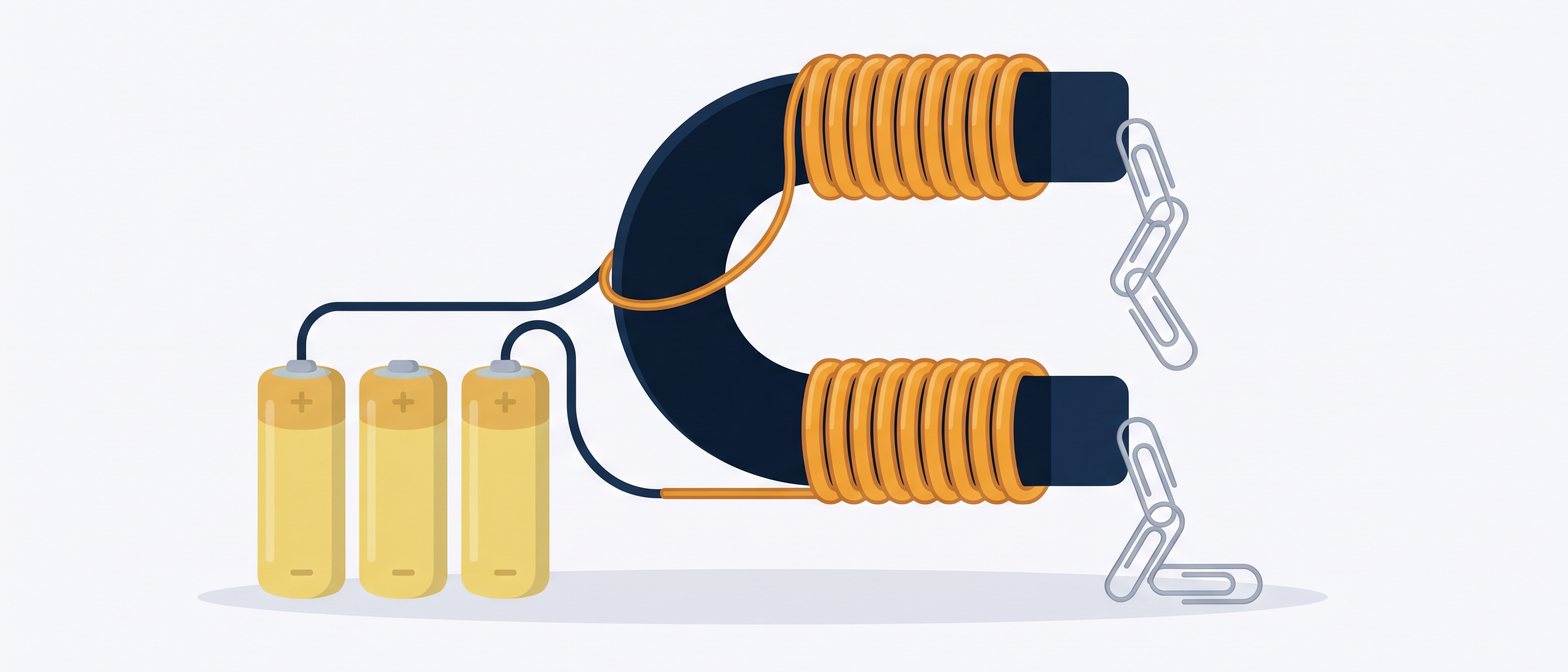
Pick up a nail. It does not attract any other nails — it is not a magnet. Now coil a wire around it, connect the wire to a battery, and suddenly the nail picks up paperclips! Remove the battery and the paperclips drop. That nail with its coil of wire is an .
Two parts make it work together:
- The iron core gives the magnet something to magnetise. Iron is easily magnetised — it lines up its internal domains when current flows, then scrambles them when current stops.
- The coil of wire carries electric current, and moving charges produce a magnetic field around the wire. Wrap the wire in a coil and the fields from each loop add together to produce one stronger field through the iron core.
🤔 Predict first: A student wraps wire around a wooden rod instead of an iron rod. Will the electromagnet be as strong?
Why is it temporary?
Leave a normal bar magnet on your table and it stays magnetic for years. An electromagnet is different — it is a .
The moment you disconnect the battery, the current stops, the magnetic field collapses, and the iron core loses its magnetism almost instantly. This is actually very useful: a crane in a scrapyard uses a powerful electromagnet to pick up a car, then simply cuts the current to drop it exactly where it is needed. If it were a permanent magnet, getting the car off would be almost impossible.
🤔 Predict first: The current in an electromagnet is switched off. What happens to the paperclips it was holding?
What makes an electromagnet stronger?
Here is where the real experiment comes in. You can control three things to change the strength of an electromagnet:
- Number of coils (turns of wire) — more turns means more loops of wire each adding to the magnetic field. Double the turns and the magnet roughly doubles in strength.
- Amount of current (number of batteries) — more batteries push more current through the wire, and more current means a stronger magnetic field around each turn.
- Size of the iron core — a larger iron core can hold a stronger magnetic field and concentrates it more effectively.
In your PSLE, "strength" is measured by how many paperclips (or how heavy an object) the electromagnet can hold. Try the experiment below — adjust the coils and batteries and see the paperclip count change in real time.
Does the electromagnet get stronger with more coils and more batteries?
Predict first: How can you make an electromagnet pick up MORE paperclips?
North pole and south pole
Like every magnet, an electromagnet has a and a . Which end is north depends on which way the current flows through the coil.
One extremely useful feature: you can reverse the poles by reversing the direction of the current (swapping the battery connections). This makes electromagnets used in electric motors and MRI machines incredibly flexible — something a permanent bar magnet cannot do.
🤔 Predict first: A student reverses the battery connections in an electromagnet circuit. What happens to the poles?
Watch out — easily mixed up
Quick recap
🎯 Mastery check
Answer all 8 — your progress is saved on this device.
Which two parts are needed to make an electromagnet?
A student turns off the battery connected to an electromagnet that is holding iron nails. What happens to the nails?
A student wants her electromagnet to pick up more paperclips. She already has 10 turns of wire and 1 battery. What should she change?
A scrapyard crane uses an electromagnet to lift a car. Why is an electromagnet better for this job than a permanent magnet?
Two electromagnets are identical except electromagnet A has 5 turns of wire and electromagnet B has 15 turns. Which is stronger, and why?
A student reverses the battery connections in her electromagnet. What changes?
Which of the following is NOT a way to increase the strength of an electromagnet?
An MRI machine uses a powerful electromagnet. Why must the current be kept flowing at all times while a patient is inside?