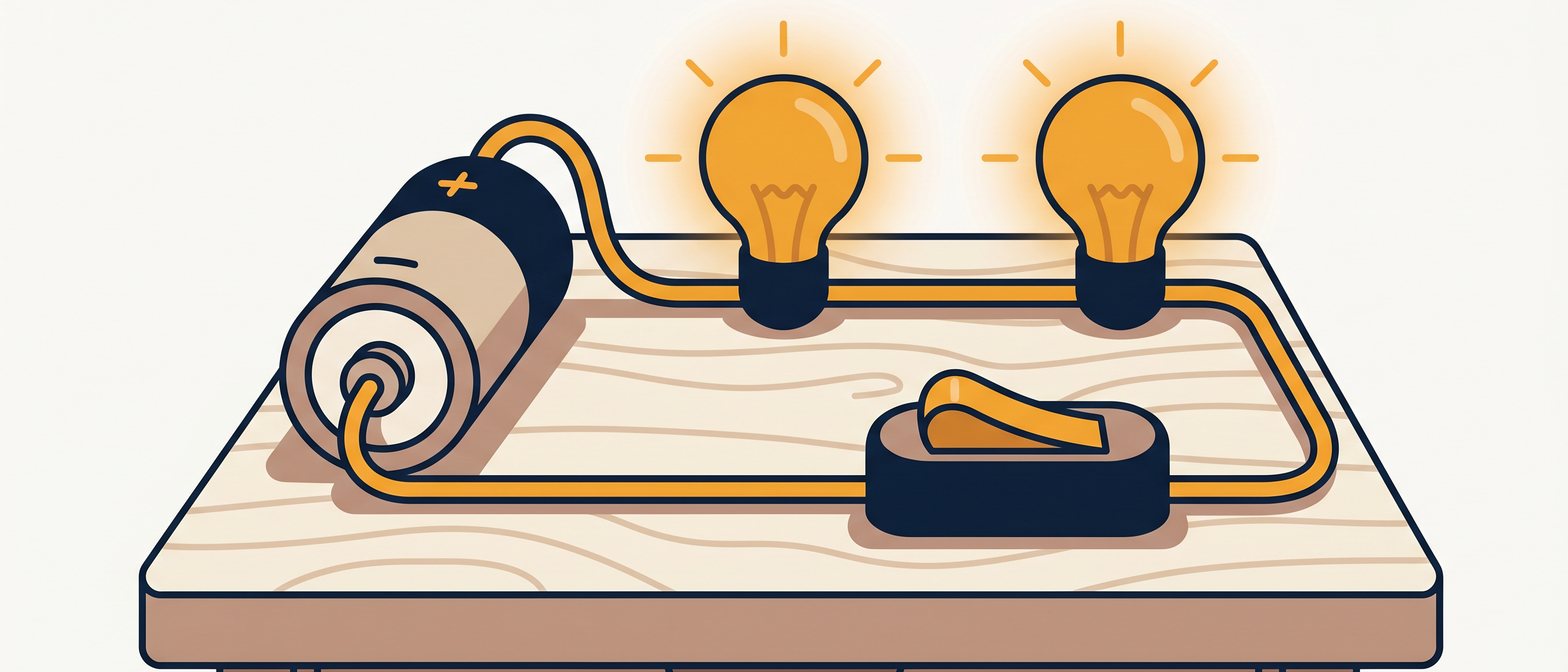
The Electrical System
What an electric circuit needs to work, how a switch opens and closes it, and why bulbs behave differently in series and parallel.
⏱ 10 min · 🎯 4 things to master
You flip the light switch at the void deck and the lights come on. You flip it back and they go off. That one small switch controls the flow of electricity through a whole circuit — and understanding exactly why is the key to scoring full marks in your PSLE Systems questions.
Parents: the experiment below asks your child to predict before each step — let them commit to a guess out loud before they tap. Saying "I think the bulb will go dark because the circuit is broken" is exactly how the science sticks.
By the end you will be able to explain: what a circuit needs to work, why a switch matters, and how series and parallel circuits behave differently when you remove a bulb. Those four ideas mirror the four things your PSLE marker is looking for.
What every circuit needs
Nothing in your home runs on electricity without a complete loop. Think of electricity like water flowing through a pipe — if there is a gap anywhere in the pipe, the water stops. A circuit works the same way.
Every circuit has three essential parts. First, a — the battery that provides the push. Second, that form the path. Third, a — the bulb, the buzzer, or the motor that does something useful with the electricity.
If any one of these is missing, electricity cannot flow and your device will not work.
Open circuit vs closed circuit
Here is the most important idea in this whole topic: electricity can only flow around a complete loop. The moment there is a gap anywhere in that loop, the flow stops immediately.
A is a complete, unbroken loop. Electricity flows and the bulb lights up. A has a gap. No electricity flows, no light, no sound — nothing.
A is simply a device that creates or closes that gap on purpose. Flip the switch one way and you close the gap — closed circuit, bulb on. Flip it the other way and you open the gap — open circuit, bulb off. That is all a switch does.
🤔 Predict first: If the switch in a circuit is open, what happens to the bulb?
Now build the circuit yourself and try flipping the switch.
Build-a-circuit experiment
Predict first: If you open the switch, what happens to the bulb?
Series circuits
In a , every component sits on the same single loop. The electricity has only one path to travel — it must pass through every single component in turn.
This has two important consequences for bulbs:
First, the bulbs share the energy from the battery. Two bulbs in series are each dimmer than one bulb alone would be, because the energy is divided between them.
Second, remove one bulb and you create a gap in the only path. Both bulbs go out — even the one that is still there. This is exactly how older strings of fairy lights used to work: one broken bulb and the whole string went dark.
Parallel circuits
In a , each component has its own separate branch back to the battery. The electricity does not have to choose — it travels down all branches at the same time.
This has two important consequences:
First, each bulb gets its own full supply of energy from the battery, so bulbs in parallel are brighter than bulbs in series (and as bright as a single bulb on its own).
Second, if you remove one bulb, only that branch loses its path. The other branches are completely unaffected. The remaining bulbs stay lit. This is how the lights in your HDB flat are wired — if one room's bulb blows, the other rooms stay on.
🤔 Predict first: In a parallel circuit with two bulbs, you remove one bulb. What happens to the other bulb?
Series vs parallel — side by side
Here is a quick comparison to lock it in before you check yourself:
| Series circuit | Parallel circuit | |
|---|---|---|
| Path for electricity | One shared loop | Separate branches |
| Bulb brightness | Dimmer (share energy) | Brighter (own energy) |
| Remove one bulb | Both go out (open circuit) | Others stay lit |
| Used where | Simple switches, older fairy lights | Home wiring, most real circuits |
Watch out — these are easily mixed up
Quick recap
🎯 Mastery check
Answer all 8 — your progress is saved on this device.
A circuit has a battery, two wires and a bulb. The switch is open. What happens to the bulb?
Which THREE components must every working circuit have?
Two bulbs are connected in series to a battery. Bulb A is removed. What happens to bulb B?
Two bulbs are connected in parallel to a battery. Bulb A is removed. What happens to bulb B?
Compare the brightness of one bulb alone versus two bulbs in series. How does the brightness change?
The lights in your classroom stay on even when the teacher turns off one switch by the door. Are the classroom lights wired in series or parallel, and why?
A student says "I opened the switch so the circuit is now open for electricity to travel." What is wrong with this statement?
Your friend wants to wire two bulbs so that: (a) both are as bright as possible and (b) if one bulb blows, the other stays on. Which wiring should your friend choose, and why?