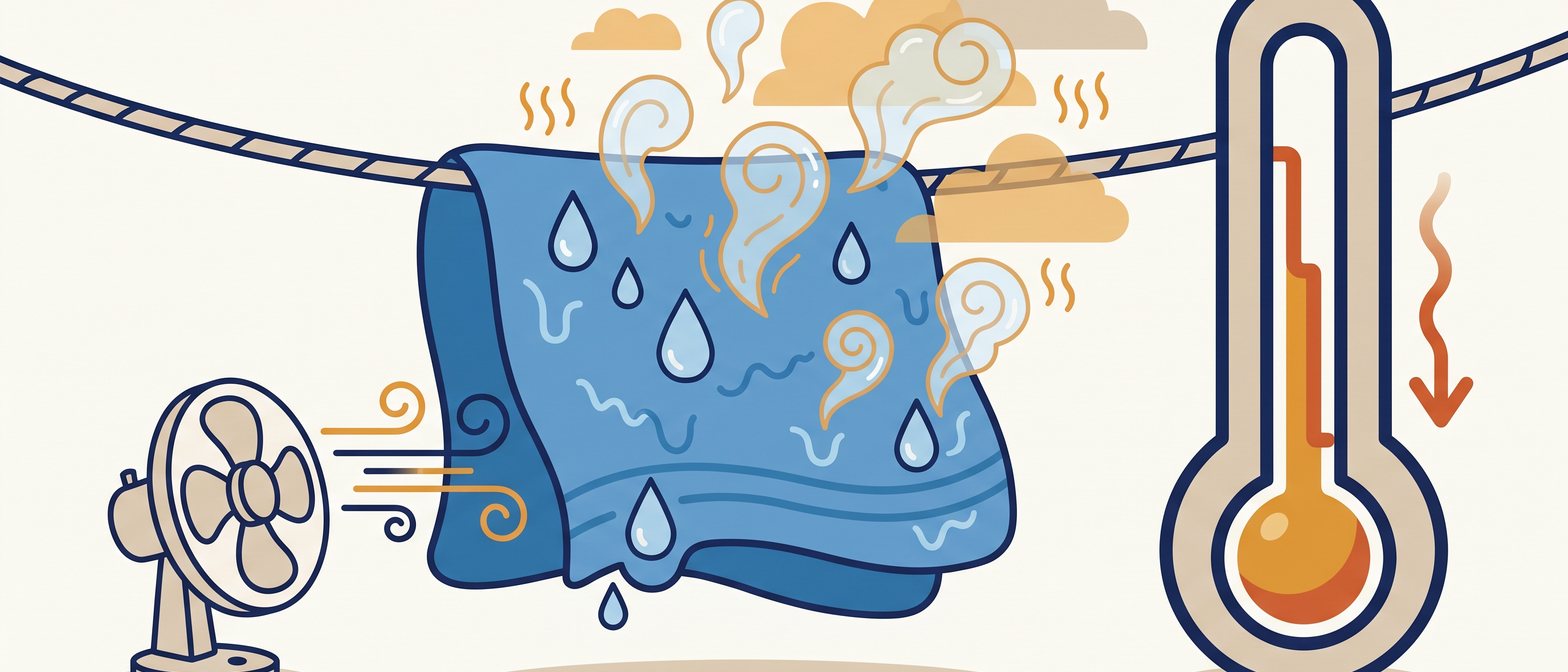
Cooling Effects of Evaporation
Why evaporation makes things feel cold, and the factors — heat, wind, surface area and humidity — that speed it up or slow it down.
⏱ 11 min · 🎯 5 things to master
Step out of the school swimming pool and — wow, you feel cold! But you were not cold in the water. What changed? Nothing except the thin film of water left on your skin. That water starts to evaporate, and as it does, it carries heat away from your skin. Your skin loses heat, and that is why you shiver. This is the cooling effect — and it shows up everywhere in your daily life.
Parents: each section has a predict step your child should attempt before reading the answer — let them commit to a guess out loud first. The tappable blue words are definitions, and the "Teacher's tip" boxes highlight useful science keywords.
By the end of this note you will be able to explain why evaporation causes cooling, name the three P5 factors that speed it up, and spot this effect in everyday Singapore situations. Lower humidity is included as optional enrichment. Here is what we will master: why evaporation cools, what speeds evaporation up, and everyday examples.
Why Evaporation Causes Cooling
Water is made of tiny particles that are always moving. The fastest-moving particles have enough energy to escape from the surface of the water and become . When they escape, they carry that energy away with them — and that energy is heat.
Here is the key idea: when the fast, energetic particles leave, the ones that stay behind have less energy on average. Less energy means lower temperature. So the liquid — and whatever it is resting on — becomes cooler. The wet towel on your forehead after a fever draws heat away from your head as water evaporates from it. Your skin feels cooler because heat has left with the escaping water.
🤔 Predict first: Why does your skin feel cold when water on it evaporates?
Faster Evaporation Means More Cooling
Not all evaporation is equal. A soaked singlet drying in a hot, breezy corridor cools you far more than a barely-damp cloth in a still, cool room. The reason is simple: the faster water evaporates, the more heat is removed in a short time, so the cooling effect is greater. Faster evaporation = more cooling.
Try the cooling experiment below. Set the conditions and watch the thermometer drop.
Cooling experiment: how much does a wet surface cool down?
Predict first: Which dries faster and feels cooler: a wet towel in the wind or in still air?
Three P5 Factors That Speed Up Evaporation
Your experiment above showed that changing conditions changes how fast water evaporates. The P5 core factors are temperature, wind and exposed surface area. Each one makes it easier or harder for water particles to escape into the air. Humidity is included later as optional enrichment.
Higher temperature
Warm air has more energy. When the air around a wet surface is warm, the water particles gain energy faster and more of them escape. speeds up evaporation.
Think of wet laundry hanging on your HDB corridor on a hot afternoon versus a cool, overcast morning. The laundry dries much faster in the heat.
More wind
Wind blows away water vapour that has already escaped from the surface. If that vapour stays close to the surface, it slows down further evaporation (the air above the surface becomes humid and "full" of water vapour). Wind removes that vapour and keeps fresh, dry air coming. speeds up evaporation.
This is why wet clothes dry faster on a breezy day, even if it is not very warm.
Larger exposed surface area
Imagine folding a wet towel into a small square versus spreading it out flat. In the small square, very few water particles are at the surface where they can escape. Spread out flat, thousands more particles reach the air at the same time. speeds up evaporation.
This is why you spread wet shoes by the door instead of leaving them stuffed together.
Optional enrichment — lower humidity
tells you how much water vapour is already in the air. If the air is already full of water vapour (high humidity), it is hard for more water to evaporate — there is no "room." In dry air (low humidity), water escapes easily. Lower humidity speeds up evaporation.
This is why Singapore's humid air makes sweat feel less effective at cooling us down compared to a dry climate.
🤔 Predict first: Which dries faster: a wet sponge left in a still room with humid air, or the same sponge placed in a breezy room with dry air?
Everyday Examples in Singapore
Evaporation cooling is not just something that happens in a laboratory. You meet it every single day.
Sweating: Your body produces sweat (water) on your skin when you are hot. As the sweat evaporates, it takes heat away from your skin and lowers your body temperature. On a still, humid day in Singapore, sweat evaporates slowly and you feel sticky. On a breezy day, sweat evaporates faster and you cool down more.
A wet towel on your forehead: When you have a fever, a cool wet towel is placed on your forehead. As the water evaporates, it takes heat from your forehead and you feel cooler. This is exactly the cooling effect of evaporation.
Drying clothes: Wet clothes hung up to dry lose water through evaporation. The clothes (and anything they touch) become cooler as a result. A fresh load of laundry straight from the wash feels cool because it is evaporating so quickly.
Cooling effect after rain: After a rain shower, the ground and surfaces are wet. As the water evaporates under the sun, the surrounding air and surfaces lose heat — which is why things feel cooler right after rain even when the sun comes back out.
🤔 Predict first: An athlete wears a wet cooling vest at a race in Singapore. Which property of evaporation makes the vest useful?
Watch out — these are easily mixed up
Quick recap
🎯 Mastery check
Answer all 8 — your progress is saved on this device.
Why does your skin feel cold after you get out of the swimming pool?
Two wet cloths are left to dry. One is spread out flat; the other is folded into a small square. Which dries faster, and why?
A student places a wet finger in front of a fan in the same room and notices it feels colder. Which factor has changed?
On a hot, breezy afternoon, sweat cools you faster than on a cool, still morning. Why?
A nurse places a wet cloth on a patient who has a high fever. Which property of evaporation makes this helpful?
Which change would make a wet surface cool down MORE quickly?
A student wraps a water bottle in a sealed plastic bag so the water cannot evaporate. Will the bottle cool the surroundings? Why?
After a rain shower, the ground feels cooler even though the sun has returned. What is the most likely reason?