Examples of Condensation in Everyday Life
Why cold surfaces like a drink can or a mirror turn wet: water vapour in the air cooling into droplets, and where that water really comes from.
⏱ 11 min · 🎯 4 things to master
You pull a cold can of Milo from the freezer bag and within a minute the outside is dripping wet. Your friend says the can is leaking. But wait — you haven't opened it yet. So where is all that water coming from? This note helps you investigate the answer.
Parents: the interactive experiment below lets your child set the temperature of a drink can and observe what happens. Let them predict first before they click "Observe" — saying the answer out loud before seeing it is the fastest way to make it stick.
By the end you will be able to explain where the water on a cold surface comes from, name four everyday examples, and use the keyword . The four ideas to master are what condensation is, why a surface must be cool enough, where you see it every day in Singapore, and how it connects to evaporation.
What is condensation?
The air around us is never completely dry. Even on a clear sunny day in Singapore, the air is packed with . You cannot see it or feel it. It is just there, floating as a gas.
When that invisible water vapour touches a surface that is cold enough, it loses energy and changes back into tiny liquid water droplets. Those droplets appear on the surface — visible to the naked eye. That change from water vapour (gas) to liquid water is called .
🤔 Predict first: A cold drink can gets wet on the outside. Where does the water come from?
Try the virtual experiment below. Set the surface temperature and see what happens.
Does water appear on the outside of a cold drink can?
Predict first: Where does the water on the outside of a cold drink can come from?
Why does it only happen on cold surfaces?
Think of the air like a giant invisible sponge. Warm air can hold a lot of water vapour without any of it turning into liquid. But once air near a surface cools down enough — below what scientists call the — the vapour can no longer stay as a gas. It turns into liquid. The dew-point idea is optional enrichment; for the P5 core, remember that the surface must be cool enough relative to the nearby moist air.
This is why a warm mug of tea does not get droplets on the outside, but a cold can of Pokka green tea does. The mug is warm, so the air around it stays warm and holds its vapour. The cold can chills the air right next to the metal until the vapour turns to liquid.
Everyday examples in Singapore
You do not need a laboratory to see condensation. Here are five places you spot it every day:
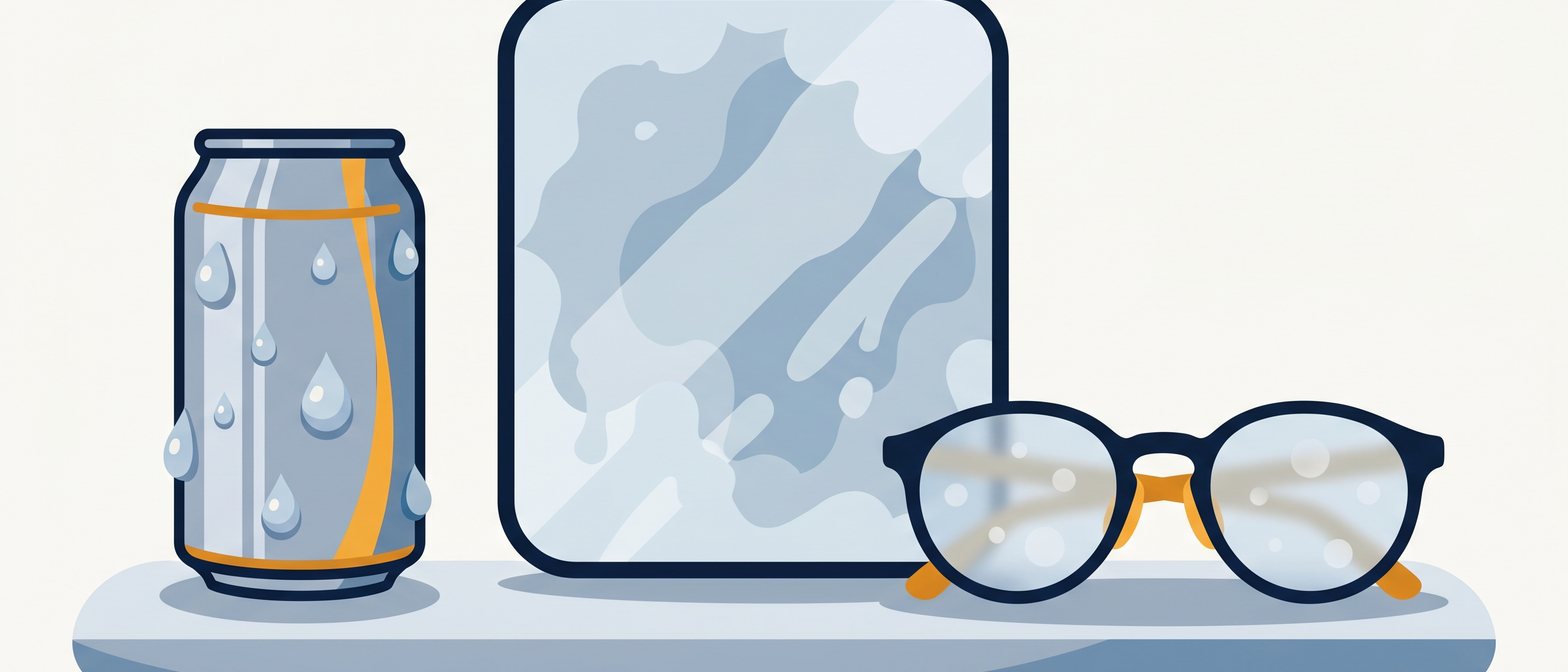
Cold drink can or bottle. Pull a cold 100PLUS from the school canteen fridge. Droplets appear on the outside almost immediately. Water vapour from the warm, humid Singapore air hits the cold metal and condenses.
Bathroom mirror after a shower. Hot water from the shower turns into steam (water vapour) that fills the bathroom. When that warm vapour touches the cooler mirror surface, it condenses into a thin layer of droplets — the mirror fogs up.
Spectacles walking out of an air-conditioned room. Your spectacles are cool from the air-conditioned classroom. You step into the humid void deck and the warm, moist air outside condenses on the cool lenses. They fog over for a few seconds until the lenses warm up to the outside temperature.
Dew on grass in the morning. At night, the ground cools down quickly. Water vapour in the air condenses onto the cool grass blades, leaving tiny droplets — . By mid-morning the sun warms the grass and the dew evaporates.
Clouds. High in the sky, air rises, expands and cools. Water vapour in that rising air condenses into millions of tiny water droplets, which clump together to form a . Clouds are condensation happening on a massive scale.
🤔 Predict first: You walk from an air-conditioned MRT station into the hot and humid outdoor air. Your spectacle lenses immediately fog up. What is happening?
Condensation is the reverse of evaporation
In the water cycle, evaporation and condensation are partners. changes liquid water into water vapour (liquid → gas). changes water vapour back into liquid water (gas → liquid). They are exact opposites.
| Process | Direction | What happens |
|---|---|---|
| Evaporation | liquid → gas | Water gains energy and escapes as vapour |
| Condensation | gas → liquid | Water vapour loses energy and becomes liquid |
When puddles on the pavement after rain slowly disappear on a sunny day, that is evaporation. When the cold bus window fogs up in air-conditioned comfort on a humid morning, that is condensation. Same water — different directions.
🤔 Predict first: Which statement is correct about the relationship between evaporation and condensation?
Watch out — these are easily mixed up
Quick recap
🎯 Mastery check
Answer all 8 — your progress is saved on this device.
A cold bottle of water is left on a table in an air-conditioned room. After a while, the outside of the bottle is wet. Where did the water come from?
Your bathroom mirror fogs up after a hot shower. Which process caused this?
Which of the following surfaces would you expect condensation to form on?
Condensation is described as the reverse of evaporation. What does this mean?
Early in the morning, grass in a Singapore garden is covered in tiny water droplets. What is the correct name for this, and how did it form?
You pour hot soup into a cold bowl straight from the fridge. Which surface is most likely to show condensation, and why?
A student says water vapour turning into rain in a cloud is the same as condensation on a drink can. Is the student correct?
Which pair correctly describes evaporation and condensation?