Classification of Plants
The two main plant groups — flowering plants that make seeds, and non-flowering plants that spread by spores — and how to tell them apart.
⏱ 8 min · 🎯 2 things to master
Look around your garden, the void deck, or the plants at home. There are thousands of different plants in the world, so how do scientists sort them all out? It turns out you only need to ask one question to put almost any plant into its big group: does it grow flowers, or not? That one question splits every plant into two groups — flowering plants and non-flowering plants. In this note you'll learn how each group makes new plants, you'll sort six plants yourself, and you'll catch the sneaky fern that fools so many students.
Parents: the blue dotted words are tappable definitions, and the green "Predict first" box and the sorting game let your child guess before they reveal the answer — that guess-then-check is where the learning sticks. Fifteen minutes tapping through this together beats an hour of silent reading.
By the end you'll be able to look at any plant and decide which of the two groups it belongs to, using the exact words your PSLE marker is waiting for. Let's start with the group you already know best.
Flowering plants
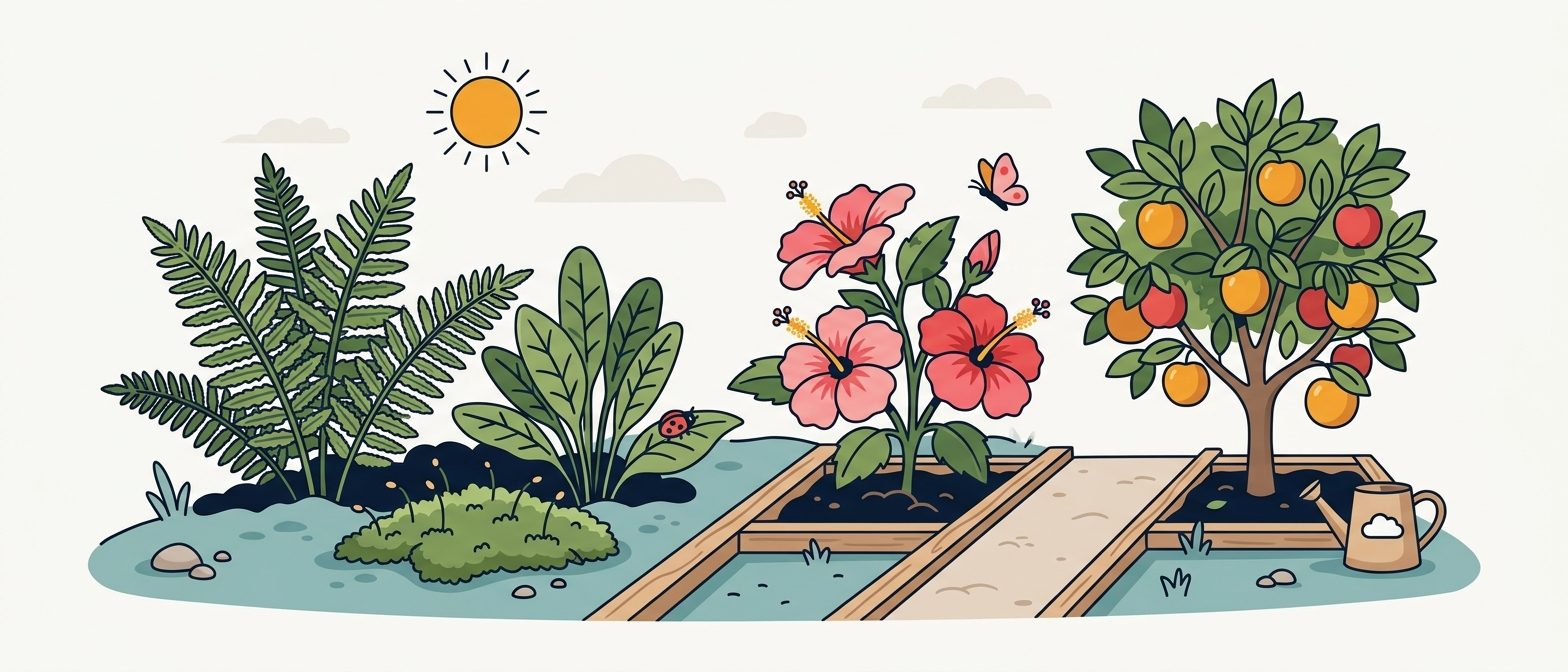
Think of a hibiscus, a rose, or a durian tree. What do they all have? At some point, they grow flowers. A plant that grows flowers belongs to the group called .
But the flower is only the start of the story. After a flower has done its job, it slowly develops into a . And inside that fruit are the . So the chain goes like this: the plant grows a flower, the flower becomes a fruit, and inside the fruit are the seeds. Flowering plants make new plants by their seeds.
Here is a surprise that trips people up. In science, a "fruit" is any part that holds seeds — not just the sweet ones you eat for dessert. A tomato has seeds inside, so a tomato is a fruit. A green bean pod holds seeds, so it is a fruit too. So when you see a plant with mango, durian, rice grains, or bean pods, you are looking at fruits with seeds inside — a flowering plant.
Non-flowering plants
Now picture a fern growing on a damp wall, or a soft patch of green moss near a drain. Watch them as long as you like — they never grow a single flower. A plant that does not grow flowers belongs to the group called .
No flowers means no fruits, and no fruits means no seeds. So how do these plants make new plants? They use . Spores are tiny — much smaller than seeds — and the plant makes lots of them.
If you turn over a fern leaf, you'll often spot rows of little brown or orange dots on the underside. Those are the , and they store the spores until the plant is ready to release them. So non-flowering plants like ferns and mosses reproduce by their spores, not seeds.
Inspect a plant up close and decide which group it belongs to — look for the clues that matter.
Inspect the plant — how does it reproduce?
Predict first: A fern has no flowers. Does it make seeds or spores?
Which group is it?
Now it's your turn to sort. But first, a quick prediction — this is the exact trap PSLE loves to set.
🤔 Predict first: A fern has big, green, leafy fronds and no flowers at all. Is it a flowering or non-flowering plant?
Now sort each plant below. Tap a plant to find out which group it belongs to and why.
Sort the plants
Predict first: A fern has big green leaves. Flowering or non-flowering?
Notice the pattern: every plant with flowers, fruits, or seeds went into the flowering group, while the fern and moss went into the non-flowering group because they use spores.
Watch out
Here are the two mistakes students make most often. Learn them now and you'll catch easy marks.
Quick recap
🎯 Mastery check
Answer all 7 — your progress is saved on this device.
A plant grows colourful flowers that later turn into fruits. Which group does it belong to?
A fern has large green leaves but never grows any flowers. Which group is it, and why?
How do non-flowering plants like ferns and mosses make new plants?
Where are the seeds of a flowering plant found?
A student turns over a fern leaf and sees rows of little brown dots underneath. What are these?
A tomato has many small seeds inside it. In science, what is a tomato?
A student writes that a moss is a flowering plant because it is green and leafy. Why is this wrong?