Cell System
The microscopic building blocks of every living thing, how plant and animal cells differ, and the job each cell part does.
⏱ 11 min · 🎯 3 things to master
Here is a fact that might surprise you: right now, as you read this, your body contains roughly 37 trillion cells. Every organ, every drop of blood, every bit of skin is made of cells. But here is the really interesting part — a tiny leaf cell and one of your own cheek cells are not identical. A plant cell has some extra equipment that makes it a small food factory. In this note you will explore both types of cell, find out what each part does, and practise useful science keywords.
Parents: start with the predict gate in the first experiment — let your child guess before the cells appear. The blue dotted words are tappable definitions, and the "Teacher's tip" boxes highlight useful keywords. Ten minutes of active predicting is worth an hour of passive reading.
By the end you will be able to describe what both cells have in common and what makes plant cells different. The four big ideas are: cells as building blocks, parts shared by both cell types, parts found only in plant cells, and the function of each part.
Cells are the smallest building blocks of living things
Slice a piece of HDB garden grass as thin as a piece of paper and look at it under a microscope — you will see tiny boxes, all packed together like tiles on a bathroom floor. Those boxes are . Every plant, every animal, every fungus, every bacterium is made of cells. You are made of cells. A blade of grass is made of cells. Even a single-celled bacterium is, by itself, a complete living unit.
The key PSLE idea: cells are the basic building blocks of living things. Nothing living is built from anything smaller.
🤔 Predict first: Your body is made up of many, many tiny units. What are these units called?
Parts that BOTH plant and animal cells share
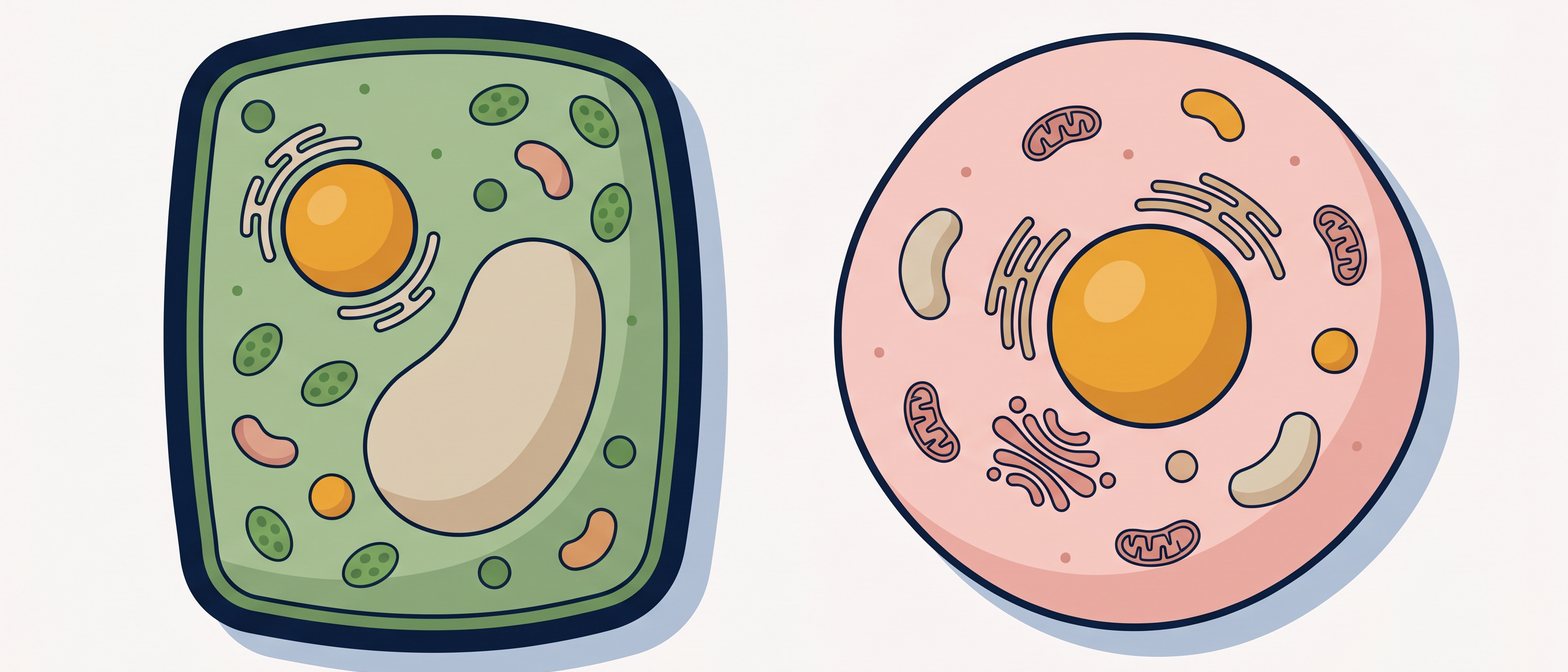
Open a cheek cell (animal) and a leaf cell (plant) side by side, and you will find three parts in common. These are the common parts in the typical plant and animal cells being compared here. Cell types such as bacteria can differ, so the detailed comparison below is optional enrichment rather than a definition of every living cell.
Cell membrane
The wraps around the outside of the cell like a very thin skin. It is in charge of what goes in (nutrients, water) and what goes out (waste). Every cell — plant or animal — has a cell membrane.
Function: the cell membrane controls what enters and leaves the cell.
Cytoplasm
is the watery gel inside the cell membrane. Think of it like the filling in a bao (bun): it surrounds and cushions everything inside. Chemical reactions that keep the cell alive happen in the cytoplasm.
Function: the cytoplasm fills the cell and is where chemical reactions take place.
Nucleus
The is the round structure sitting inside the cytoplasm. It contains the cell's instructions (DNA), telling the cell when to grow, when to divide, and what proteins to make. Think of it as the headquarters of the whole cell operation.
Function: the nucleus controls all the activities of the cell.
Parts found ONLY in plant cells
Here is what makes plant cells special. A plant cell is a food factory — it can make its own food using sunlight. To do that, it needs some extra equipment that animal cells simply do not have.
Cell wall
Outside the cell membrane, plant cells have a tough extra layer called the . It is made of a tough material called cellulose and acts like a firm box around the cell. It gives the plant cell its fixed, rectangular shape and stops it from bursting when it takes in a lot of water.
Animal cells do NOT have a cell wall — that is why animal cells are often round or irregular in shape.
Function: the cell wall gives the plant cell a fixed shape and provides support and protection.
Chloroplasts
are small green structures scattered through the cytoplasm of plant cells. They contain a green pigment called , which captures sunlight. The chloroplast uses that light energy, plus water and carbon dioxide from the air, to make food (glucose) for the plant. This process is called photosynthesis.
Animal cells do NOT have chloroplasts — animals cannot make their own food the way plants can.
Function: chloroplasts contain chlorophyll and are where photosynthesis takes place.
Large vacuole
A is a fluid-filled storage sac. Plant cells have ONE very large central vacuole that can take up most of the inside of the cell. It stores water, salts, and other substances, and it helps push the cell contents outward, keeping the plant firm and upright. When a plant wilts, it is partly because its vacuoles have lost water.
Animal cells may have small vacuoles or none at all — nothing like the massive central vacuole in a plant cell.
Function: the large vacuole in plant cells stores water and helps keep the plant firm and upright.
Now explore both cells. Predict first, then tap each part to read its function.
Compare an animal cell and a plant cell
Predict first: Which parts does a plant cell have that an animal cell does NOT?
🤔 Predict first: Which of these parts would you find in a plant cell but NOT in an animal cell?
Functions of each cell part — summary table
Here is a quick-reference for every part your marker might ask about:
Match each part to its function
Predict first: What does the nucleus do?
Watch out — these are easily mixed up
Quick recap
🎯 Mastery check
Answer all 8 — your progress is saved on this device.
What is the smallest building block of all living things?
Which THREE parts are found in BOTH plant cells and animal cells?
A student says "animal cells have a cell wall." Is this correct?
Which part of the plant cell makes food for the plant?
A plant wilts and droops when it does not get enough water. Which cell part is most directly responsible for keeping the plant firm?
What is the function of the nucleus?
A scientist looks at a cell under a microscope. It is rectangular with a thick outer layer and green dots inside. Is this a plant cell or an animal cell? Which features tell you?
Which part controls what enters and leaves a cell — in both plant AND animal cells?