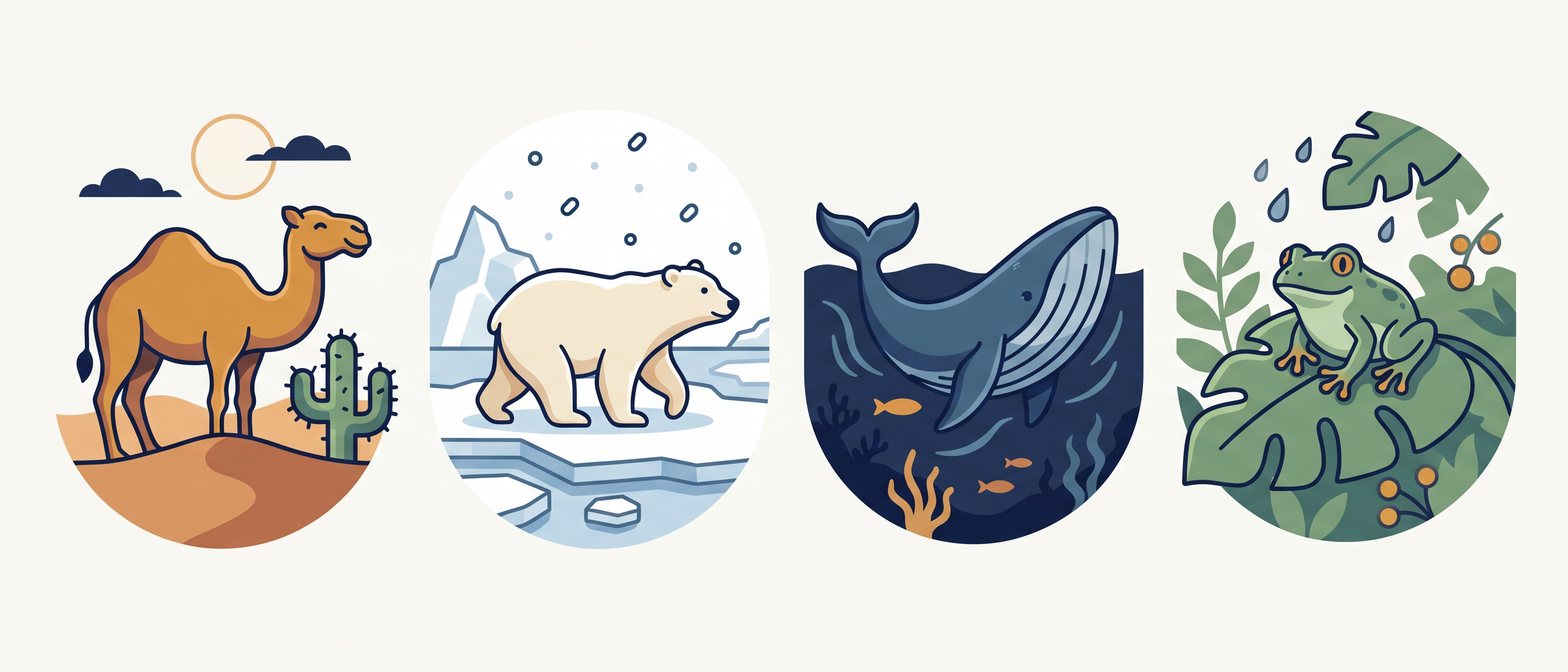
Adaptations
The special features and behaviours — from a camel's humps to a cactus's waxy skin — that help animals and plants survive in their particular habitat.
⏱ 13 min · 🎯 5 things to master
A camel in the Arctic would be miserable — and a polar bear in the Sahara Desert would not last long at all. Every living thing is built for the place it lives in. The special features that help it survive there have a name, and that name is worth a lot of marks in the PSLE Science paper.
Parents: each section has a predict step your child should try before reading on — let them tap through the virtual habitat experiment and explain why an organism survives or struggles. Saying the keyword out loud is how it sticks in memory.
By the end you will be able to name adaptations for the desert, the Arctic, the ocean, plants, and reproduction — and use the exact PSLE keyword your marker is looking for. The five big ideas we will master are: what an adaptation is, desert adaptations, cold-climate adaptations, food and predator adaptations, and reproductive adaptations. Let's go.
What is an adaptation?
Imagine you moved from an air-conditioned flat in Ang Mo Kio to the middle of the Sahara Desert with no supplies. You would be in serious trouble — your body is not built for that environment. A camel, however, thrives there, because it has the right features for that place.
An is a special feature or behaviour that helps an organism survive in its . Every organism has a set of adaptations that match where it lives. Features that help an animal find food, stay safe from predators, or cope with the climate are all adaptations.
Desert adaptations — the camel and the cactus
The desert is extremely hot during the day, bitterly cold at night, and bone dry. Very little water and food are available. Organisms that live there need special features to deal with the heat and the lack of water.
The camel
The camel is the icon of desert survival, but its most famous feature is often misunderstood. A camel's humps store fat, not water. When food is scarce, the camel breaks down the fat in its humps to release energy. This means it can go for days without eating. Other adaptations include:
- — spread the camel's weight so it does not sink into soft sand.
- Long, thick eyelashes and closeable nostrils — block blowing sand from the eyes and nose.
- The ability to drink a huge amount of water in one go (up to 135 litres) and store it in its blood plasma — so it can go long periods without drinking.
The cactus
Plants need water to survive, but water is very hard to come by in the desert. The cactus has a brilliant set of adaptations for this:
- A thick, waxy stem that stores water inside — the whole stem is a water tank.
- A (instead of a wide leaf) — spines have a very small surface area, so very little water escapes by evaporation, and they also protect the cactus from animals.
- A wide, shallow root system spreading far around the plant — catches rainwater quickly over a large area whenever it does rain.
🤔 Predict first: A cactus has spines instead of wide leaves. How does this help it survive in the desert?
Cold-climate adaptations — the polar bear
The Arctic is the opposite of the desert: freezing temperatures, strong icy winds, and a landscape of snow and ice. Staying warm and finding food are the biggest challenges here.
The is superbly adapted to this extreme cold:
- Thick fur and a thick layer of blubber (fat) under the skin — both trap body heat and insulate the polar bear against the freezing air and icy water. The blubber layer can be up to 11 cm thick.
- White fur — camouflages the polar bear against the snow, letting it sneak up on prey like seals without being spotted.
- Large, slightly webbed paws — work as paddles for swimming in Arctic water and spread the bear's weight on ice so it does not fall through.
- Small ears — reduce the surface area of the body that loses heat to the cold air.
Adaptations for getting food and avoiding predators
Not all adaptations are about temperature or water. Many are about finding food and staying safe.
Getting food:
- The eagle's sharp, hooked beak and strong talons are adaptations for catching and tearing apart prey.
- The giraffe's long neck is an adaptation that lets it reach leaves at the tops of tall trees that other animals cannot reach.
- The anteater's long, sticky tongue is an adaptation for reaching deep into ant tunnels.
Avoiding predators:
- The stick insect's stick-like body is an adaptation that makes it look like a twig, hiding it from birds.
- A hedgehog's sharp spines are an adaptation that makes it painful to swallow — most predators leave it alone.
- A chameleon's ability to change colour is an adaptation that makes it blend into its surroundings.
🤔 Predict first: A stick insect looks exactly like a twig. How does this help it survive?
Adaptations for reproduction
Survival also includes producing the next generation. Some animals have features or behaviours that help them find and attract a mate. A peacock's large, colourful tail can help it attract a mate. A bird's call can also help it find a mate of its own kind.
Plants have reproductive adaptations too. Fruits and seeds may have wings, hooks, hairs, or fleshy coverings that help them move away from the parent plant. Wind, water, or animals can then carry them to a new place where they can grow. The seed or fruit feature is a structural adaptation for dispersal.
🤔 Predict first: Which example shows an adaptation that helps an organism reproduce?
Survive the Habitat — virtual experiment
Pick an organism and drop it into a habitat. Does it survive? Predict first!
Survive the Habitat
Predict first: How do a camel's humps help it survive in the desert?
Plant adaptations — not just desert and Arctic
Plants cannot move away from harsh conditions, so their adaptations have to be built in. We have already seen the cactus. Here are three more important plant habitats and their adaptations.
Rainforest plants — getting enough light: Rainforest canopy trees block most of the light. Plants on the forest floor have evolved large, broad leaves to catch as much of the available light as possible — their wide surface area is an adaptation for absorbing light in a shaded habitat.
Aquatic plants (like the water hyacinth or lotus):
- — position the leaf at the water surface where sunlight is brightest.
- Air spaces inside the leaf and stem — keep the plant buoyant so it floats rather than sinking.
- Long, flexible stems — grow up through the water from roots in the muddy bottom below.
Windy clifftop or open grassland plants:
- — reduces water loss through evaporation on windy, exposed hillsides.
- Low-growing, cushion-shaped growth form — stays below the wind and reduces the risk of being torn apart.
Watch out — these are easily mixed up
Quick recap
🎯 Mastery check
Answer all 8 — your progress is saved on this device.
What is an adaptation?
What is stored in a camel's humps?
How does a cactus survive in the desert without much water?
A polar bear has thick fur and a thick layer of fat under its skin. How do these features help it survive in the Arctic?
A stick insect looks exactly like a brown twig. How does this adaptation help it survive?
A water lily has large floating leaves. How does this adaptation help the plant?
A polar bear has white fur. How is this an adaptation for surviving in the Arctic?
Which example shows an adaptation that helps an organism reproduce?