
The Unchanged Quantity
How to spot the quantity that stays fixed, align before-and-after ratios, and use the change to find one unit.
⏱ 10 min · 🎯 4 things to master
Constant Part Explained with Bar Models | Singapore Primary Maths
The ratio changes, but the story usually tells you what stayed still. In an art club, eight boys join while no girls join or leave. The boys change; the girls are the firm handrail. Find that handrail first and the ratio puzzle becomes a before-and-after picture you can line up.
Parents: let your child point to the group that stayed unchanged and make a guess before revealing each model step.
By the end you will be able to identify an unchanged quantity, match its units across two ratios, and use the difference to solve for the original amounts.
Spot the quantity that stayed still
The phrase no girls joined or left gives you more information than the new ratio does. The girls are an . They may be shown by a different number of ratio units in another stage, but their actual number of girls is still the same.
Do not choose a part just because its name appears twice. Ask what the event did. A transfer between two groups changes both groups, so it needs a constant-total idea. Here, only boys are affected.
🤔 Predict first: At first, boys to girls in an art club were 3 : 5. Then 8 boys joined and no girls joined or left. Which group is the unchanged quantity?
Lock the same amount in both stages
Here is the full art-club problem:
At first, the ratio of boys to girls was 3 : 5. Then 8 boys joined and no girls joined or left. The ratio became 5 : 5. How many boys and girls were there at first?
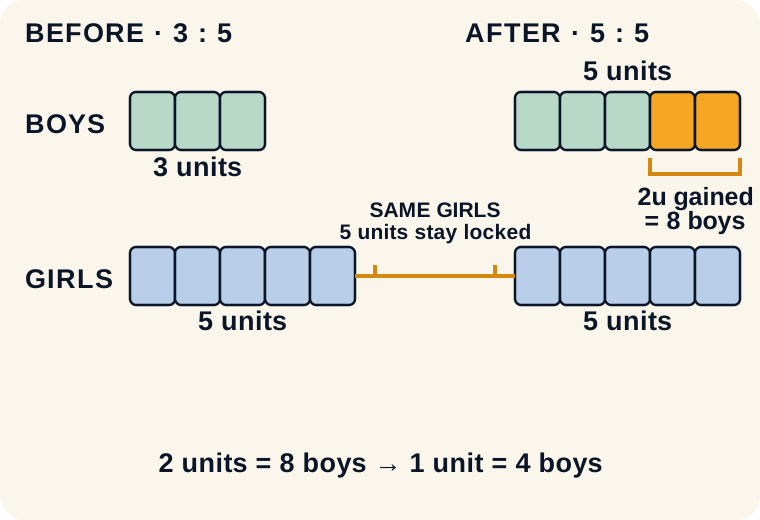
The before row is 3 units of boys and 5 units of girls. The after row is 5 units of boys and 5 units of girls. The girls already match at 5 units, so keep both girls bars the same width. This is the visual lock from the lesson video.
Sometimes the unchanged quantity has different ratio numbers. For example, if the before ratio is 2 : 3 and the after ratio is 4 : 6, the second part is 3 units before and 6 units after. Double the whole before ratio to make the unchanged part 6 units: 2 : 3 becomes 4 : 6. Scale every number in a ratio together.
🤔 Predict first: A quantity is 4 units in one ratio and 6 units in the other. What is the smallest common number that can lock it in both?
Read the gap and find one unit
Once the girls are locked at 5 units, compare the boys. They grow from 3 units to 5 units, so the added part is 2 units. The story says that added part is 8 boys.
That gives the working:
Find one unit
Now read the before row, because the question asks for the original counts. The original boys were 3 units, or 3 × 4 = 12. The girls were 5 units, or 5 × 4 = 20.
Use the adjustable model below. The two bars show only the boys before and after; the girls are already locked at 5 units in the drawing above. Set one unit until the added boys equal 8.
Art club: find one unit from the added boys
Predict first: The boys change from 3 units to 5 units. How many units were added?
The check is quick: 12 boys plus 8 gives 20 boys. The 20 girls stay put, so the final ratio is 20 : 20, which simplifies to 5 : 5. The starting ratio is 12 : 20, which simplifies to 3 : 5.
Choose the right constant
Before-and-after problems can hide different constants. Match the story to the event:
- One group is untouched while another joins or leaves → lock the unchanged quantity.
- One person gives to another inside the same pair → the total stays constant.
- The same amount is added to both quantities → the difference stays constant.
🤔 Predict first: Tom has 18 red counters and 11 blue counters. He gives 4 red counters to a friend outside the set. Which quantity is unchanged inside the set?
Watch out — easily mixed up
Quick recap
Graduated practice
Try the direct match first, then a removal, then a ratio that needs scaling. Open each solution only after you have written your own unit equation.
1. Added red cards
Red cards to blue cards were 4 : 7. Nine red cards were added, and the ratio became 7 : 7. Blue cards did not change. Find the original counts.
Show solution
The blue part is already 7 units in both rows. Red gains 3 units, so the actual addition tells us the value of one unit.
Practice 1
The original counts were 12 red cards and 21 blue cards. Check: after 9 red cards join, the counts are 21 : 21.
2. Apples removed
Apples to oranges were 5 : 4. After 12 apples were used, the ratio became 2 : 4. No oranges changed. Find the original counts.
Show solution
Orange stays at 4 units. Apples lose 3 units, so the 12 used apples are the three-unit gap.
Practice 2
The starting counts were 20 apples and 16 oranges. Check: 8 : 16 simplifies to 2 : 4.
3. Match a different scale
Green counters to yellow counters were 2 : 3. Fifteen green counters were added, and the ratio became 5 : 6. Yellow counters stayed fixed. Find the original counts.
Show solution
Match yellow at 6 units by changing the before ratio from 2 : 3 to 4 : 6. Green gains one unit, so the 15 added counters give the unit value.
Practice 3
The original counts were 60 green counters and 90 yellow counters. Check: after adding 15, 75 : 90 simplifies to 5 : 6.
🎯 Mastery check
Answer all 7 — your progress is saved on this device.
The ratio of red to blue beads is 4 : 5. Some blue beads are removed and it becomes 4 : 3. Which colour is unchanged?
A quantity is 5 units before and 3 units after. To align it, which common number can both ratios reach?
After alignment, one quantity grows from 3 units to 5 units. If 8 children joined, what is 1 unit?
Apples to oranges were 5 : 4. Twelve apples were used and the ratio became 2 : 4. Oranges stayed fixed. What were the original counts?
Green to yellow counters were 2 : 3. After 15 green counters were added, the ratio became 5 : 6. What were the original counts?
A child gives some stickers to a friend. Which quantity is usually the constant anchor for this internal transfer?
Before and after alignment shows a gain of 2 units. The story says 8 boys joined. Which statement is correct?