
Repeated Identity
How to spot a shared quantity, scale both ratios until it matches, then solve the combined three-way ratio.
⏱ 9 min · 🎯 4 things to master
Repeated Identity Explained with Bar Models | Singapore Primary Maths
Two ratio statements can describe one set of beads from different viewpoints. Red to blue might be 3 : 2, while the same blue beads to green are 4 : 5. Blue has two numbers, but it is one actual collection. Match that repeated identity, then the three colours can share one model.
Parents: ask your child to circle the repeated quantity in both statements and predict which ratio must be scaled before showing the joined model.
By the end you will be able to identify a repeated identity, align its unit count, combine two ratios without double-counting, and solve for each amount.
Find what is shared
The is the quantity that appears in both ratios. In “red : blue = 3 : 2” and “the same blue : green = 4 : 5”, blue is the identity. The wording “the same” confirms that both blue entries refer to one collection.
🤔 Predict first: Red : blue = 3 : 2 and the same blue : green = 4 : 5. Which is the repeated identity?
Make the shared quantity match
Here is the full question:
In a craft box, the ratio of red beads to blue beads is 3 : 2. The ratio of the same blue beads to green beads is 4 : 5. There are 225 beads altogether. How many beads of each colour are there?
The first ratio calls the blue collection 2 units. The second calls the same blue collection 4 units. Make the first ratio equivalent by doubling both entries. It becomes 6 : 4. The second ratio stays 4 : 5. Now both descriptions give blue the same 4-unit size.
Align the repeated identity
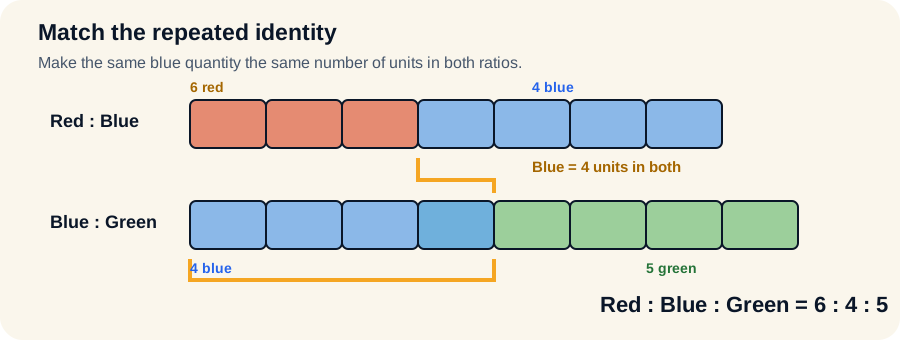
🤔 Predict first: Red : blue is 3 : 2. To make blue equal to 4, what is the matching red number?
Count the identity once and solve
After alignment, red, blue and green are 6, 4 and 5 units. Add each distinct colour once. There are 15 units altogether, and the total is 225 beads.
Find one unit
The interactive model lets you adjust one unit until the combined total is 225. Blue appears in both source ratios but enters the total only once.
Join the ratios, then find one unit
Predict first: How many distinct units are in 6 : 4 : 5?
Check both original ratios
Repeated identity is not always a time change
The identity can be a person, length, number of objects or a shared region. It does not have to be a before-and-after event. If a quantity truly changes between stages, use a method built around that event instead.
🤔 Predict first: Two rectangles have left-only : overlap = 2 : 1 and the same overlap : right-only = 3 : 4. What is shared?
Watch out — easily mixed up
Quick recap
Graduated practice
1. Books
Fiction to reference books are 5 : 2. The same reference books to comics are 3 : 4. There are 174 books altogether. Find each number.
Show solution
The shared reference count is 2 in the first ratio and 3 in the second. Match it at 6 units: 5 : 2 becomes 15 : 6, while 3 : 4 becomes 6 : 8.
Practice 1
Check: 90 : 36 = 5 : 2, 36 : 48 = 3 : 4, and the total is 174.
2. Savings
Ali's savings to Bea's are 2 : 3. Bea's savings to Chen's are 4 : 5. They have $280 altogether. Find each amount.
Show solution
Bea is 3 units in the first ratio and 4 in the second. Match at 12 units: the ratios become 8 : 12 and 12 : 15.
Practice 2
Bea is counted once even though Bea appears in both source ratios.
3. Shared overlap
Two paper rectangles overlap. Left-only area to overlap area is 2 : 1. The same overlap area to right-only area is 3 : 4. The union area is 117 cm². Find the three distinct regions.
Show solution
Match the overlap at 3 units. The first ratio becomes 6 : 3 and the second becomes 3 : 4, so the union is 13 units.
Practice 3
The overlap is 27 cm² and is included once in the union, so 54 + 27 + 36 = 117 cm².
🎯 Mastery check
Answer all 7 — your progress is saved on this device.
In P : Q = 2 : 3 and Q : R = 4 : 5, which is the repeated identity?
Q is 3 units in one ratio and 4 units in the other. At what number can you match Q?
To change 2 : 5 into 4 : 10, what must you do?
Red : Blue : Green = 6 : 4 : 5 and the total is 225. What is one unit?
With Red : Blue : Green = 6 : 4 : 5 and 1 unit = 15, how many blue beads are there?
Why must the repeated identity be aligned before combining the ratios?
Why is the shared blue amount included once in the 225-bead total?