
The Remainder Model
How to name the parent whole for each fraction, re-cut a remainder into equal units, and solve two-stage fraction problems.
⏱ 9 min · 🎯 4 things to master
Which Whole? Fractions of a Remainder Explained | Primary Maths
The word remainder changes the parent of a fraction. If of the books on a trolley are storybooks, then of the remaining books are comics, that is not cut from all the books. It is cut from the leftover . Name each whole before you calculate and the model stays honest.
Parents: ask your child to point to the parent whole for each fraction and predict the next cut before revealing the worked model.
By the end you will be able to identify each fraction's parent whole, enlarge the remainder without changing its amount, and solve a two-stage remainder problem.
Name the parent whole
A is the amount the fraction is talking about. In “ of all the books”, the parent is the entire trolley. In “ of the remaining books”, the parent is only the books left after storybooks are set aside.
The is still part of the original whole, but it can become a new parent for the next fraction. That is the key move.
🤔 Predict first: of a trolley are storybooks. of the remaining books are comics. The is taken from…
Cut the original bar, then re-cut the leftover
Work through this trolley problem:
of the books on a trolley are storybooks. of the remaining books are comics. The rest are information books. There are 48 information books. How many books are on the trolley?
First cut all books into 5 equal shares. Storybooks take 2 shares, leaving a remainder of 3 shares. Now look only at those 3 remainder shares. of them is 1 share of comics, leaving 2 shares of information books.
The diagram below enlarges the three-share remainder so that its inner cut is easy to see. The enlargement is a focus view: it does not create more books.
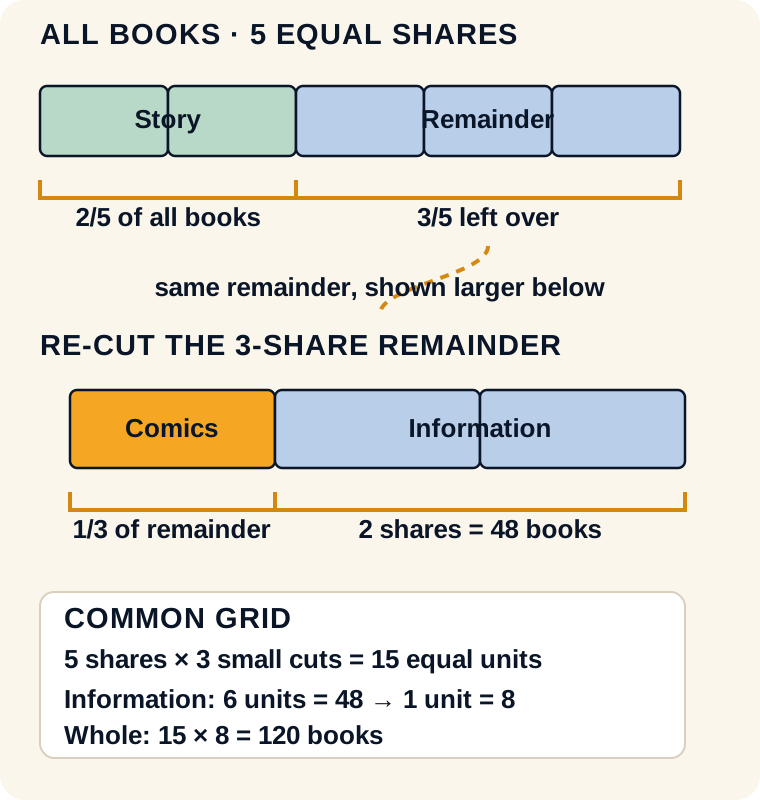
The information books occupy 2 original shares. Use the known information count to value a share, then read the five-share original bar.
Find the whole trolley
🤔 Predict first: If the remainder has 3 equal shares and is comics, how many remainder shares are information books?
Re-cut into one common small unit
The two cuts can be combined into one exact grid. Five original shares, each split into three small pieces, make 15 equal small units. In that grid:
Make equal small units
The 48 information books fill 6 small units. The re-cut makes each piece comparable without changing the number of books.
Value the small unit
Use the adjustable experiment below. Predict which part is the parent, then step the value of one small unit until the information section matches 48.
Trolley books: re-cut the remainder
Predict first: After are storybooks, the applies to which parent?
🤔 Predict first: In the 15-unit grid, information books occupy 6 units and total 48. What is one small unit?
Check the whole before you add fractions
The nested model gives a clean check:
Check each parent whole
The categories add to 48 + 24 + 48 = 120. Notice that of the original 120 would be 40, but comics are 24 because the fraction was taken from the smaller remainder of 72.
🤔 Predict first: A tank is full. Then of the water is used. What fraction of the full tank was used in the second step?
Watch out — easily mixed up
Quick recap
Graduated practice
These move from naming the parent to handling two fractions that share the original whole. Open each solution only after you have named its parent whole.
1. Art books and biographies
of a shelf is art books. of the remaining books are biographies. The final 18 books are atlases. How many books are on the shelf?
Show solution
Use 12 original shares. Art uses 3, leaving 9. Biographies use 6 of those 9, leaving 3 shares for atlases.
Practice 1
Check: 18 art, 36 biographies, 18 atlases.
2. Beads left after yellow
of 84 beads are yellow. of the remainder are blue. How many beads are neither yellow nor blue?
Show solution
Yellow beads are of 84. Then calculate the second fraction from the remainder.
Practice 2
3. Two parts of the same total
of 90 cards are red and of the same 90 cards are blue. The rest are green. How many are green?
Show solution
Both fractions name the original 90 cards, so neither fraction is taken from a remainder.
Practice 3
The words “the same 90 cards” keep both fractions on the original parent whole.
🎯 Mastery check
Answer all 7 — your progress is saved on this device.
Ben read of a book, then of the remainder the next day. The applies to…
After spending of some money, what fraction is left as the remainder?
A bar is split into 5 shares and each share is re-cut into 3 equal small units. How many units make the whole bar?
A boy spends of his money, then of the remainder. What fraction of the original money is the second amount?
In a remainder model, 6 equal small units carry 48 information books. What is one unit?
Why is + wrong for the trolley problem?
A shelf has 12 original shares. The final atlas part is 3 shares and equals 18 books. What is the total shelf size?