
Percentage Change: Find the Whole
Name the percentage you know, find one percent, and scale to the whole.
⏱ 7 min · 🎯 4 things to master
30% Off — What Was the Original Price? | PSLE Maths
Video · 3:36
means out of one hundred. Percentage questions become friendlier when you name the amount you know, find an equal part, and then scale to the whole or compare the change with the original.
Parents: ask your child whether the given amount is the original whole, a remaining part, or a changed amount before calculating. That label prevents most percentage mistakes.
By the end, you will be able to find an original whole, apply a discount or increase, find a percentage change from two amounts, and check whether an answer should move up or down.
Name the percentage you know
A discount removes a stated percentage from the original. An increase adds a stated percentage to it. Singapore GST is also handled using the rate stated in the question.
🤔 Predict first: A jacket costs $120 before a 25% discount. What percentage of the original price is left?
So a 30% discount leaves 70% of the original price.
Work backwards from a discount
A backpack costs $84 after a 30% discount. The paid price is 70% of the original price. Find the original price.
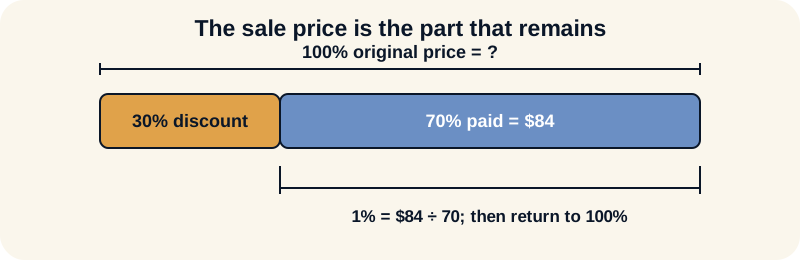
Find the original price
Predict first: A 30% discount leaves 70%. Is $84 the whole price or a part of it?
Scale to 100%
The answer is larger than the paid amount because 70% is only part of the original. Check by finding 30% of $120 and subtracting it. A different valid route could find the 30% discount first, but this page practises the unitary sequence: one equal part, then the whole.
Find percentage change from the original amount
When both the original and new amounts are given, first find the change. Then compare that change with the original amount, because the original is the reference whole.
For an increase from $80 to $100, the change is $20. Compare that change with the original amount and choose the denominator before calculating.
🤔 Predict first: $80 becomes $100. Which amount is the denominator for the percentage increase?
Show the worked solution
The original amount is the denominator, so the increase is 25%.
80 to 100: increase
For a decrease from $100 to $80, the change is again $20, but the original is now $100. The percentage decrease is therefore 20%, not 25%.
100 to 80: decrease
Increase, GST, and simple interest
For a percentage increase, add the rate to 100%. A 25% increase makes 125% of the original. Singapore GST at 9% makes 109% of the price before GST. Simple interest is a stated percentage of the original principal for the stated time.
Translate an increase
A 25% increase
Keep the base amount clear: a percentage increase is calculated from the original, not from the already increased price.
Compare a part with the whole
Sometimes a question asks for the percentage represented by a ratio. If red beads and blue beads are in the ratio 3:5, there are 8 equal parts altogether. Red beads are 3 of those 8 parts.
Convert a ratio to a percentage
Three practice problems
1. A game costs $63 after a 10% discount. Find the original price.
Find the whole
2. Red and blue counters are in the ratio 3:5. What percentage are red?
Use total parts
3. A $50 meal has 9% GST. Find the total bill.
Add GST
Watch out — easily mixed up
Quick recap
🎯 Mastery check
Answer all 8 — your progress is saved on this device.
After a 30% discount, what percentage of the original price remains?
If 70% is $84 in the backpack example, what should you find next in the taught unitary method?
If 70% of the original price is $84, what is the original price?
A price increases from $80 to $100. What is the percentage increase?
A price decreases from $100 to $80. What is the percentage decrease?
Singapore GST at 9% makes a price what percentage of the price before GST?
A ratio is 3:5. What percentage of the total is the first part?
If a reverse-percentage answer is smaller than the discounted amount, what should you do?