
Making Units Equal
How to align equal portions from two ribbon rolls, read the resulting ratio, then use one unit to solve.
⏱ 9 min · 🎯 4 things to master
Equal Fractions: Match the Equal Portions | Singapore Primary Maths
Two fractions can look unrelated even when the pieces they describe are the same size. If of a red ribbon roll equals of a blue ribbon roll, the fractions are not equal as numbers. Their actual portions are equal. Make those portions line up and the two whole lengths become a ratio.
Parents: let your child predict which numbers should match before revealing the common portion, then ask them to check both original fractions at the end.
By the end you will be able to recognise equal fractional portions, make their numerators match, read the resulting ratio, and solve for the requested amount.
Know when the portions are equal
Use this method when a question says that a fraction of one whole has the same amount as a fraction of another whole. The two wholes may be ribbons, money or collections of objects. A statement such as “ of red equals of blue” is about two equal portions from two different bars.
The counts the pieces in the known portion. The denominator tells how many of those pieces make the whole. First match the number of pieces in the two known portions; only then can you compare the wholes.
🤔 Predict first: of red equals of blue. What must be made equal first?
Make the numerators match
Here is the full question:
of a red ribbon roll has the same length as of a blue ribbon roll. The two rolls are 186 centimetres long altogether. Find the length of each roll.
The equality is between of red and of blue. Make the highlighted portions both 6 small units, the lowest common multiple of 2 and 3. For red, two original parts become six common units, so each red part is three common units and the whole is fifteen. For blue, three original parts become six common units, so each blue part is two common units and the whole is sixteen.
Match the equal portions
Now both highlighted portions contain 6 equal units. The individual common unit has the same length on both bars. The red whole has 15 units and the blue whole has 16 units, so the ratio is 15 : 16.
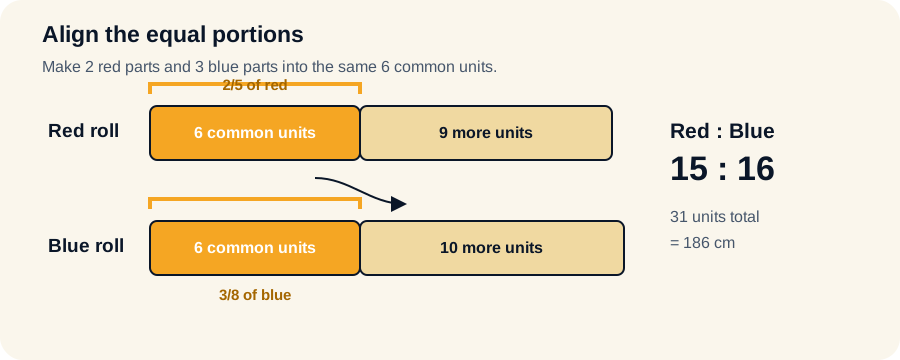
🤔 Predict first: What common numerator aligns and ?
Turn the ratio into one unit
After alignment, red has 15 units and blue has 16 units. Together the rolls are 186 cm, so 31 common units make 186 cm.
Find one unit
Use the adjustable bar trainer to set one common unit from the total. Predict the ratio first, then move the value until 31 units total 186 cm.
Equal portions: find one common unit
Predict first: After matching the portions, what is red : blue?
Check both original conditions. of 90 cm is 36 cm. of 96 cm is also 36 cm. The portions match, and the totals add to 186 cm.
Check the story
Why denominators become the units
means the red whole is made of 5 equal pieces, while means the blue whole is made of 8 equal pieces. After the equal portions are rescaled to 6 common units, red has 15 units and blue has 16 units of the same size. The denominator counts all the original pieces; the rescaled total gives the comparable ratio.
🤔 Predict first: of Cara's string equals of Dan's string. What is Cara : Dan?
Watch out — easily mixed up
Quick recap
Graduated practice
Open each solution only after you have written the equal portions and the resulting ratio.
1. Strings and a total
of Alia's string equals of Ben's string. Together the strings are 170 cm long. Find each length.
Show solution
Make both portions 6 units: becomes , and becomes . The whole lengths are 8 and 9 units.
Practice 1
The equal portions are both 60 cm, and 80 + 90 = 170 cm.
2. Cards and a difference
of a box of rose cards equals of a box of tulip cards. There are 18 more rose cards than tulip cards. How many cards are in each box?
Show solution
Match the portions at 2 units. The rose box is 6 units and the tulip box is 5 units, so the one-unit difference is 18 cards.
Practice 2
of 108 and of 90 are both 36 cards.
3. Beads and a non-unit gap
of Cora's beads equals of Dan's beads. Cora has 81 more beads than Dan. Find both amounts.
Show solution
The numerators already match at 4 after changing to . Cora has 14 units and Dan has 5 units. Their difference is 9 units.
Practice 3
Both named portions are 36 beads: of 126 and of 45.
🎯 Mastery check
Answer all 7 — your progress is saved on this device.
of red equals of blue. What should be aligned first?
What common numerator aligns the 2 red parts and 3 blue parts?
After alignment, what is the red : blue whole ratio?
The two ribbon rolls total 186 cm across 31 common units. What is one unit?
of a ribbon equals of another. Together they are 170 cm. Which pair is correct?
of rose cards equals of tulip cards. Rose has 18 more cards. What are the counts?
Why is making denominators equal by itself not enough when the two wholes are different?