
The Gap-and-Difference Method
Add opposite gaps or subtract same-side gaps, then divide by the change per item.
⏱ 6 min · 🎯 4 things to master
Gap and Difference: Compare Shortage and Spare Capacity | Singapore Primary Maths
Video · 4:46
Double-if Method: Enough Cards for Both? | PSLE Maths
Video · 4:38
Some problems give you two plans for the same situation. One plan leaves a bit extra; another plan falls short. Those two gaps are the clue to the hidden number of items. This is the gap-and-difference method, also called and shortage.
Parents: let your child slide the count and watch the two plans meet before revealing the answer. The method tip names the working a marker rewards.
By the end, you will know when gaps should be added, when they should be subtracted, and how to divide by the change per item.
Find the two gaps
An excess is what is left over when a plan has more than enough. A shortage is what is still needed when a plan does not have enough. Both plans describe the same fixed amount, so the hidden count is the point where their totals agree.
🤔 Predict first: Giving each child $4 leaves $6 over. Giving each child $5 needs $3 more. Going from $4 to $5 each, does the amount needed go up or down?
Add opposite gaps
Mrs Lim has a group of campers. If she seats 5 campers at each table, 3 campers are left out. If she seats 6 campers at each table, there are 5 empty seats. How many campers are there?
At five per table, the plan is short. At six per table, the plan has spare capacity. The gaps sit on opposite sides, so they are added.
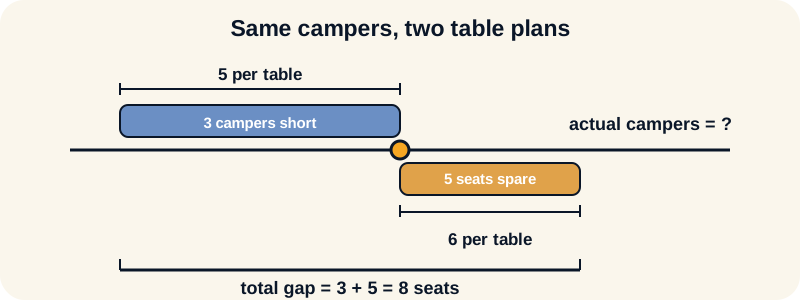
Campers: close the gap
Predict first: Moving from 5 campers per table to 6, what happens to the total number of seats?
Work the gap
Check the answer in both plans: five groups of eight plus three left out gives forty-three, and six groups of eight minus five spare seats also gives forty-three.
Subtract same-side gaps
The subtraction version is just as useful. If seven pupils per bench leave nine spare seats while six pupils per bench leave three spare seats, both gaps are on the extra side. The difference between the gaps is six seats. Each bench changes by one seat, so the number of benches is six.
Working
The check is six benches of six seats minus three spare seats: thirty-three pupils. The double-if video shows the same idea when two alternative scenarios are compared: ask what changes if the rate is doubled, then match the shared total.
A gap is not an ATEDO difference
Gap-and-difference compares two rates for the same total. ATEDO compares two quantities that differ by a known amount, then uses a ratio or a change. If the question gives “one plan has spare seats and another has campers left out”, think gap-and-difference. If it gives two ages, scores, or amounts and a constant difference, link to the constant-difference model.
Practice: close three more gaps
1. Four counters per tray leaves seven out; six per tray leaves one out. How many counters?
Working
2. Seven pupils per bench leave nine spare seats; six per bench leave three spare seats. How many pupils?
Working
3. Seven passengers per van leave four seats spare; five per van leave eight passengers out. How many passengers?
Working
Watch out — easily mixed up
Quick recap
🎯 Mastery check
Answer all 6 — your progress is saved on this device.
One plan is short and another has spare capacity. Should the two gaps be added or subtracted?
Two plans have spare capacities of nine and three. What operation finds the gap between them?
A rate changes by one seat per table and the total gap is eight seats. How many tables are there?
In the camper example, which two numbers form the opposite gaps?
After finding the number of tables, what is the safest check?
Which clue points to gap-and-difference rather than ATEDO?
Ready to close the gap? Label the two gaps, find the change per item, divide, and check both plans.