
The Equal-at-the-End Method
Find the shared final amount first, then undo each person’s change.
⏱ 6 min · 🎯 4 things to master
Equal at the End: Work Backwards to the Start | Singapore Primary Maths
Video · 4:30
Some problems give you a golden clue: at one moment, two people have the same amount. This tells you where to draw their bars. Then undo what happened to find the beginning.
Parents: ask your child to mark the equal stage before touching the starting numbers. The method tip names the reverse operation a marker wants to see.
By the end, you will be able to find a shared final amount, draw equal bars there, and work backwards carefully.
Start from the equal stage
The words equal, the same, or ended with the same tell you where to draw the bars. Do not split the initial total before accounting for what each person spent, received, or gave away.
🤔 Predict first: Two pupils end with the same number of cards. How should their bars look at the end?
Undo the changes
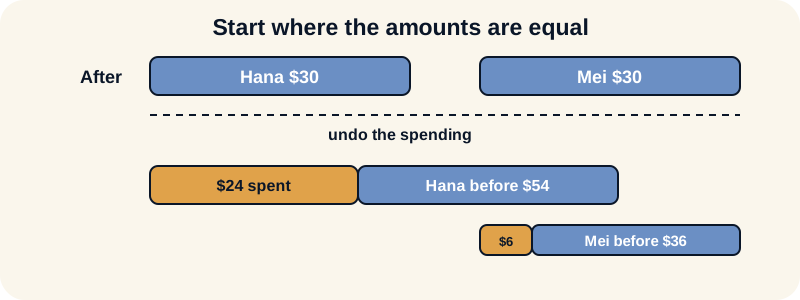
Hana and Mei have $90 altogether. Hana spends $24 and Mei spends $6. They then have the same amount. How much did each have at first?
After spending, their shared total is the original total minus the total spent. Split that shared amount equally, then add each person’s spending back.
Match the final bars
Predict first: If the final amount is $60 split equally, what is one final bar?
Work backwards
The original total checks: Hana’s starting amount and Mei’s starting amount together make ninety. After each spend, both have thirty.
Equal at the start or end
The equal stage may be at the beginning or the end. If the pupils start equal, draw the equal bars first and move forwards. If they finish equal, work backwards as in Hana’s problem. The phrase tells you the stage; the operations tell you the direction.
🤔 Predict first: Two teams have the same number of pupils after receiving bonuses. Where do you draw equal bars?
Do not confuse the total
If one person spends more than the other, their starting amounts need not be equal. The final amounts are equal only after the changes. A constant-total transfer problem keeps the total unchanged; an equal-stage problem may involve spending or receiving money from outside.
Practice: work back from equality
1. Dana and Eli have $74 altogether. Dana gives away $10 and Eli gives away $2. They then have the same amount. Find their starting amounts.
Working
2. Two teams have 68 pupils altogether. They receive bonuses of 14 and 6 pupils, then have equal totals. Find the starting team sizes.
Working
3. Ivy spends $9. Joel receives $6 from outside. They then have the same amount, and they started with $87 altogether. Find the starting amounts.
Working
Watch out — easily mixed up
Quick recap
🎯 Mastery check
Answer all 6 — your progress is saved on this device.
What does an equal-stage clue tell you to draw?
Hana and Mei spend money and then become equal. Which total should you split?
To undo money spent before the equal stage, should you add it back or subtract it again?
If one team receives a larger bonus than the other, must their starting amounts be equal?
Where should equal bars be drawn when two pupils start with the same number of cards?
What is the final check after working backwards?
Ready to line up the bars? Find the equal stage first, then work backwards one action at a time.